AI is rapidly transforming software development, making it easier, faster, and more efficient for developers to build high-quality applications. Today’s AI-powered tools go beyond simple automation—they can generate code, detect bugs, optimize performance, and even suggest solutions in real time.
For developers, this means less time spent on repetitive tasks and more time dedicated to solving complex problems and creating innovative features. Whether you are writing your first lines of code or managing enterprise-level projects, AI tools can act as intelligent partners that guide, assist, and accelerate your work.

From code editors with smart suggestions to advanced platforms that analyze and improve entire systems, these tools are reshaping the development process. This guide will highlight some of the best AI tools for developers that can enhance productivity, improve accuracy, and simplify the coding journey.
why to use AI Tools for Developers?
AI tools have become essential for developers because they significantly enhance productivity, efficiency, and creativity in software development. Traditional coding often involves repetitive tasks, debugging, and manual optimization, but AI-powered tools can automate these processes, allowing developers to focus on innovation and solving complex problems.
One of the key advantages of using AI tools is code generation and completion. Platforms like GitHub Copilot or Tabnine suggest real-time code snippets, detect syntax errors, and even write entire functions based on natural language prompts. This helps reduce coding time and minimizes human errors.
AI tools also play a crucial role in debugging and testing. They can automatically identify bugs, suggest fixes, and simulate user interactions, improving software reliability. Machine learning–based testing tools can predict where failures might occur, saving hours of manual testing.
In addition, AI enhances project management and documentation. Tools powered by natural language processing can generate accurate documentation, summarize large codebases, and provide smart insights into code dependencies.
Here are the key highlights of using AI tools for developers:
- Increased productivity – Automates repetitive coding tasks and accelerates development speed.
- Smart code generation – Suggests and writes code snippets using natural language input.
- Intelligent debugging – Detects and fixes bugs automatically, reducing human errors.
- AI-powered testing – Predicts potential failures and improves software reliability.
- Automated documentation – Generates accurate and readable documentation instantly.
- Enhanced security – Identifies vulnerabilities and suggests fixes before deployment.
- Better collaboration – Helps teams share insights and maintain consistent coding standards.
- Continuous learning – Assists developers in mastering new languages and frameworks.
- Faster project delivery – Streamlines workflows and reduces time-to-market.
- Future-ready development – Integrates advanced AI capabilities for smarter, adaptive software
Lets check out our list of best AI tools for developers one by one!
1. GitHub Copilot

GitHub Copilot remains the gold standard for AI-powered coding assistance in 2025. This revolutionary tool, powered by OpenAI’s advanced language models including GPT-4o, GPT-4.1, o3, o3-mini, Claude 3.5 and 3.7 Sonnet, and Gemini 2.0 Flash, transforms the way developers write code by providing intelligent autocomplete suggestions directly in their IDE. What sets Copilot apart is its deep integration with the GitHub ecosystem, allowing it to understand project context, coding patterns, and best practices from millions of open-source repositories.
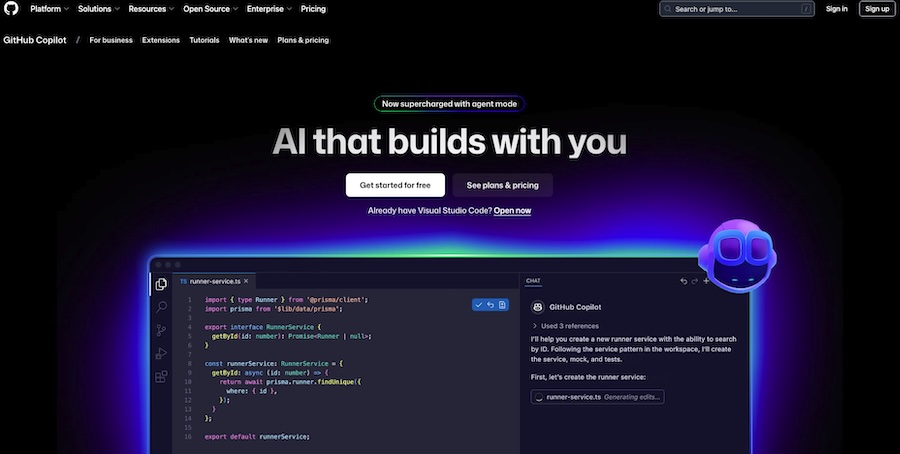
The tool excels at generating boilerplate code, implementing common algorithms, and even creating complex functions from simple comments. Its chat feature enables developers to ask questions about their code, request explanations, and get help with debugging. Copilot supports over 30 programming languages and integrates seamlessly with popular IDEs like Visual Studio Code, Visual Studio, Neovim, and JetBrains IDEs. The enterprise version offers additional features like code review assistance, security vulnerability detection, and compliance with organizational coding standards.
Recent updates have improved its ability to understand larger codebases, maintain consistency across projects, and provide more accurate suggestions for modern frameworks and libraries. With its robust free tier for students and open-source contributors, plus affordable pricing for individuals and teams, GitHub Copilot continues to democratize AI-assisted development while maintaining the highest standards of code quality and security.
2. Cursor
Cursor has emerged as the most innovative AI-powered code editor in 2025, representing a fundamental reimagining of how developers interact with their development environment. Built by Anysphere and backed by a massive $900 million funding round at a $9.9 billion valuation, Cursor is essentially a highly modified version of Visual Studio Code that integrates AI capabilities directly into every aspect of the coding experience. Unlike traditional code editors with AI plugins, Cursor treats AI as a first-class citizen in the development workflow.
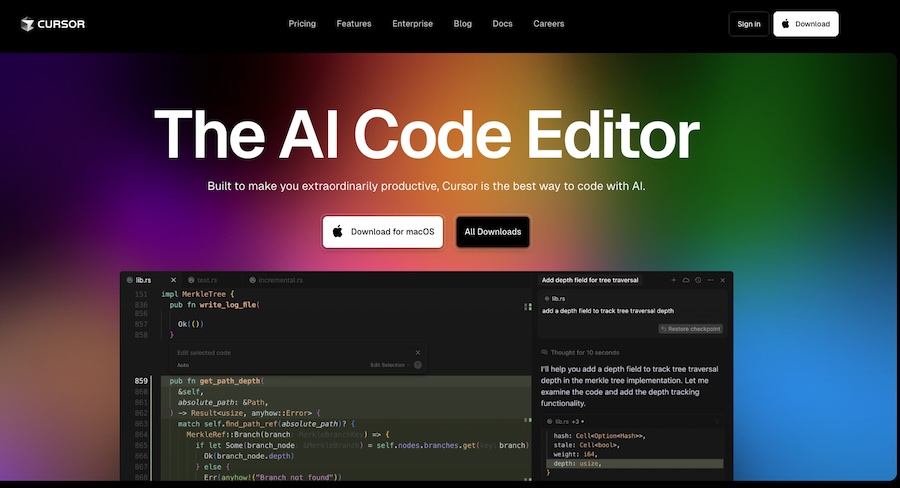
The editor’s standout feature is its ability to understand entire codebases and provide contextual suggestions that go far beyond simple autocomplete. Developers can highlight code sections and ask natural language questions, request refactoring suggestions, or even ask the AI to implement entire features. The tool’s “Composer” feature allows for multi-file editing, where developers can describe changes they want to make across multiple files, and Cursor will implement them consistently.
What makes Cursor particularly powerful is its ability to learn from a project’s specific patterns and conventions, adapting its suggestions to match the existing codebase style. The editor supports advanced features like smart imports, intelligent code generation, and seamless integration with version control systems. Its user interface is designed to minimize context switching, allowing developers to stay in flow state while leveraging powerful AI capabilities. The tool has gained massive adoption among professional developers who praise its intuitive design and the significant productivity gains it provides.
3. Windsurf by Codeium
Windsurf represents Codeium’s flagship AI-powered development environment that has quickly gained recognition for its exceptional speed and comprehensive feature set. This tool stands out in the crowded AI coding assistant market by offering a perfect balance of performance, functionality, and user experience. Windsurf provides real-time code completion, intelligent suggestions, and advanced debugging capabilities that rival the best commercial solutions while maintaining impressive responsiveness even on large codebases.

The platform excels in its ability to understand complex project structures and provide contextually relevant suggestions across multiple programming languages and frameworks. Its advanced machine learning models have been specifically trained on diverse coding patterns, making it particularly effective for full-stack development, DevOps tasks, and modern web development frameworks. Windsurf’s intelligent code analysis can identify potential bugs, suggest performance optimizations, and even recommend architectural improvements.
One of Windsurf’s key advantages is its seamless integration with existing development workflows and its ability to work effectively both as a standalone IDE and as a plugin for popular editors. The tool offers excellent support for collaborative coding, with features that help maintain code consistency across team members. Its pricing model is competitive, offering substantial value for both individual developers and enterprise teams. Recent updates have enhanced its natural language processing capabilities, allowing developers to describe complex requirements in plain English and receive accurate, implementable code solutions.
4. Claude Code (by Anthropic)
Claude Code represents Anthropic’s specialized solution for developers, bringing the powerful reasoning capabilities of Claude AI directly to the command line and development workflow. This innovative tool allows developers to delegate complex coding tasks directly from their terminal, making it an invaluable asset for automation, code review, and problem-solving. Claude Code excels at understanding nuanced programming challenges and providing thoughtful, well-reasoned solutions that go beyond simple pattern matching.
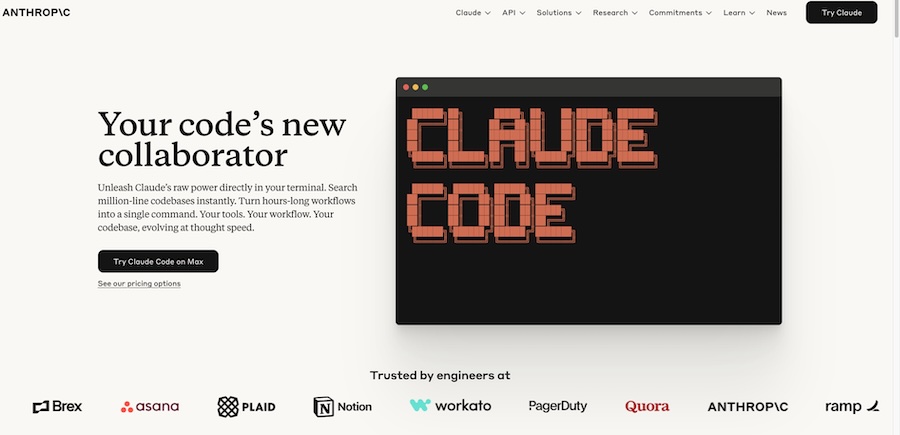
What sets Claude Code apart is its exceptional ability to understand context, maintain consistency across large projects, and provide explanations for its suggestions. The tool can handle complex refactoring tasks, generate comprehensive documentation, write test cases, and even perform code reviews with detailed feedback on potential improvements. Its natural language interface allows developers to describe problems in detail and receive not just code solutions, but also explanations of the reasoning behind the implementation choices.
Claude Code integrates seamlessly with existing development tools and CI/CD pipelines, making it particularly valuable for DevOps and automation tasks. The tool’s strength lies in its ability to understand broader project requirements and architectural patterns, providing solutions that fit well within existing systems. It supports all major programming languages and frameworks, with particular excellence in handling complex business logic and algorithmic challenges. The tool’s focus on safety and reliability makes it an excellent choice for enterprise development environments where code quality and security are paramount.
5. Aider
Aider has established itself as the premier AI pair programming tool for developers who prefer working from the command line. This powerful tool enables developers to collaborate with AI directly in their terminal, making it incredibly efficient for quick code changes, bug fixes, and feature implementations. Aider’s strength lies in its ability to understand git repositories holistically, maintaining awareness of project structure, dependencies, and coding patterns across the entire codebase.
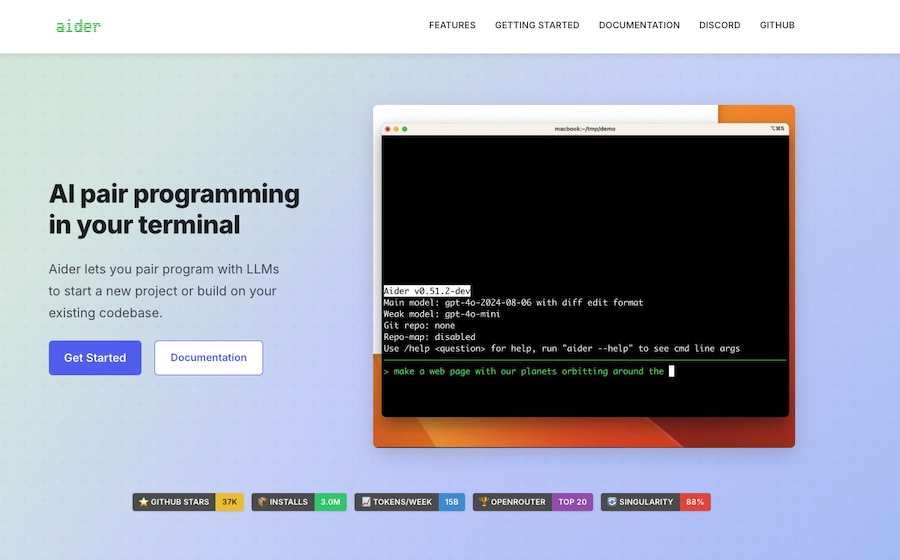
The tool excels at making surgical changes to existing code while preserving functionality and maintaining consistency with established patterns. Aider can automatically commit changes with meaningful commit messages, handle file creation and deletion, and even manage complex refactoring operations that span multiple files. Its integration with version control systems is seamless, allowing developers to review changes before they’re committed and easily revert if needed.
What makes Aider particularly valuable is its efficiency and minimal overhead. Unlike heavy IDE integrations, Aider works with any text editor and doesn’t require switching between different interfaces. It supports all major programming languages and has excellent handling of configuration files, documentation, and infrastructure code. The tool’s ability to understand natural language requests and translate them into precise code changes makes it invaluable for rapid prototyping and iterative development. Its open-source nature and active community contribute to continuous improvements and extensive customization options.
6. Zed
Zed represents the next generation of high-performance code editors, designed from the ground up for speed and collaboration with built-in AI capabilities. This editor has gained significant attention for its exceptional performance, handling large codebases with ease while maintaining responsive AI-assisted features. Zed’s architecture is optimized for modern hardware, taking advantage of multi-core processors and GPU acceleration to provide an incredibly smooth editing experience.
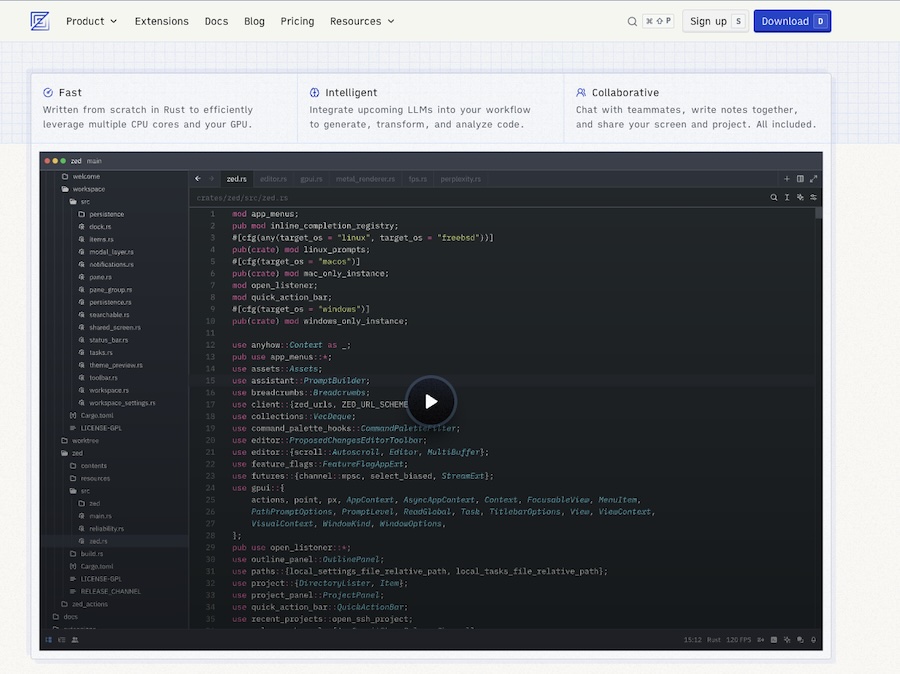
The editor’s AI integration is thoughtfully implemented, providing intelligent code completion, syntax highlighting, and real-time collaboration features that work seamlessly across distributed teams. Zed’s unique approach to AI assistance focuses on enhancing the natural coding flow rather than interrupting it, with suggestions that appear contextually and can be accepted or dismissed without breaking concentration. The tool supports extensive customization and plugin development, allowing teams to tailor the experience to their specific workflows.
Zed’s collaborative features are particularly impressive, enabling real-time pair programming with AI assistance that benefits all participants. The editor handles multiple programming languages excellently, with particularly strong support for Rust, JavaScript, Python, and Go. Its minimal resource usage and fast startup times make it an excellent choice for developers who value efficiency and performance. The tool’s focus on developer ergonomics and workflow optimization has made it increasingly popular among professional development teams looking for a modern alternative to traditional editors.
7. Replit
Replit has evolved into a comprehensive AI-powered development platform that excels at making programming accessible while providing powerful tools for experienced developers. The platform’s greatest strength lies in its ability to provide a complete development environment in the browser, eliminating setup friction and enabling instant collaboration. Replit’s AI assistant, powered by advanced language models, can help with everything from learning new programming concepts to implementing complex features in production applications.
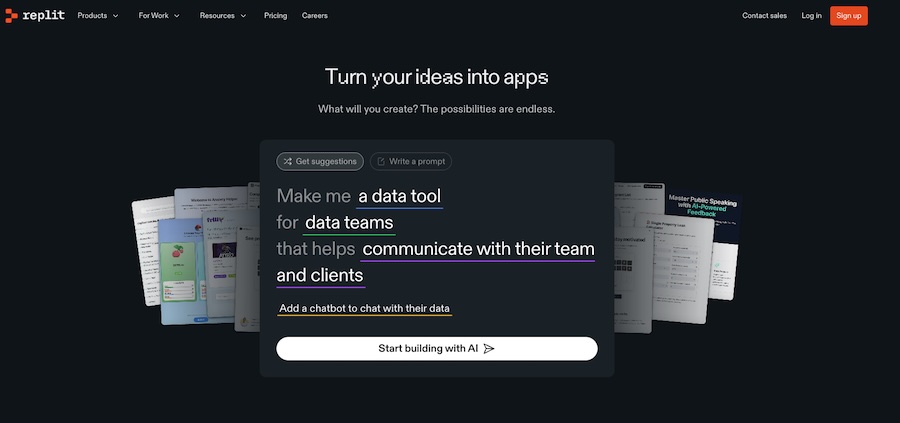
The platform’s collaborative features are exceptional, allowing multiple developers to work on the same project simultaneously with real-time synchronization and AI assistance that helps maintain code quality across contributors. Replit’s hosting and deployment capabilities are seamlessly integrated, enabling developers to go from idea to deployed application in minutes. The platform supports dozens of programming languages and frameworks, with particular excellence in web development, data science, and educational use cases.
Replit’s AI capabilities extend beyond code generation to include project planning, architecture suggestions, and even help with debugging and optimization. The platform’s community features, including code sharing and collaborative learning, make it an excellent choice for educational institutions and development teams that value knowledge sharing. Its freemium pricing model makes it accessible to beginners while offering advanced features for professional use. The platform’s continuous innovation in AI-assisted development and its focus on removing barriers to programming make it a standout choice for diverse development needs.
8. Tabnine
Tabnine has established itself as one of the most reliable and privacy-focused AI code completion tools available to developers. What sets Tabnine apart is its commitment to data privacy and security, offering both cloud-based and on-premises deployment options that meet the strict requirements of enterprise environments. The tool’s AI models are trained on permissively licensed code, ensuring that suggestions don’t inadvertently include proprietary or copylefted code that could create legal issues.
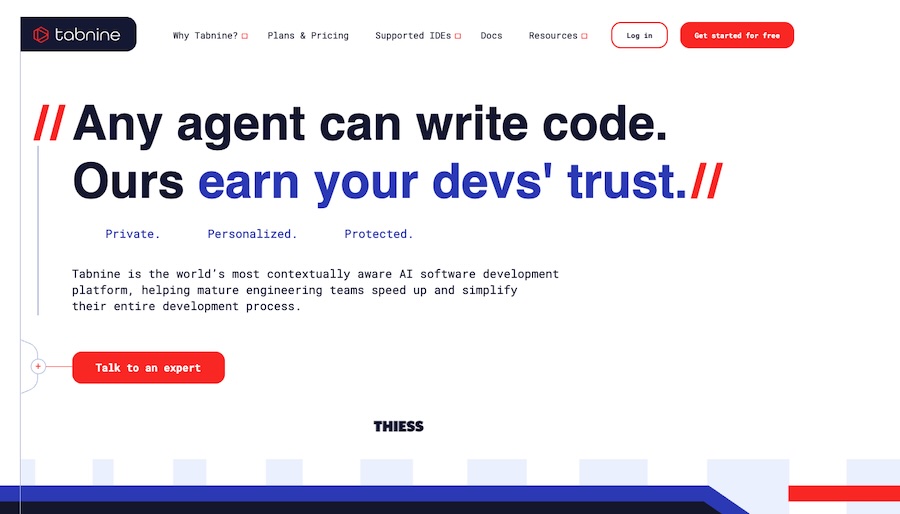
The platform provides intelligent code completion that learns from a team’s specific coding patterns and conventions, becoming more accurate and relevant over time. Tabnine supports over 30 programming languages and integrates seamlessly with all major IDEs and code editors. Its suggestions go beyond simple autocomplete to include whole-line and function-level completions that significantly accelerate development velocity while maintaining high code quality.
Tabnine’s enterprise features include advanced analytics, team management capabilities, and compliance features that make it suitable for large organizations with strict security requirements. The tool’s ability to work entirely offline when using on-premises deployment makes it valuable for organizations with air-gapped environments or strict data residency requirements. Its consistent performance across different development environments and its focus on developer productivity without compromising security make it a trusted choice for professional development teams worldwide.
9. Amazon Q Developer
Amazon Q Developer brings the power of AWS’s machine learning expertise to code generation and development assistance. This tool is particularly powerful for developers working within the AWS ecosystem, providing intelligent suggestions that are optimized for AWS services and best practices. CodeWhisperer’s integration with AWS development tools and services makes it invaluable for cloud-native development and serverless applications.
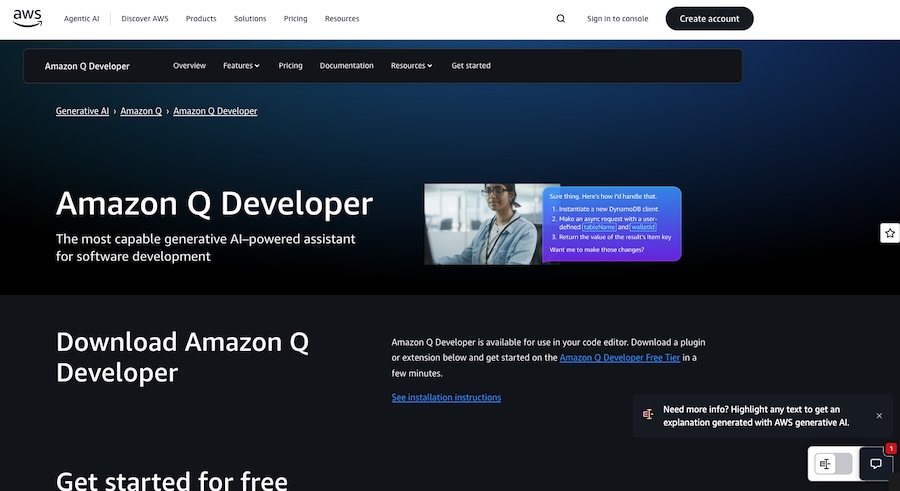
The tool excels at generating code that follows AWS security best practices and architectural patterns, helping developers avoid common pitfalls and security vulnerabilities. CodeWhisperer can generate entire functions, suggest optimal AWS service configurations, and even help with infrastructure as code development using tools like CloudFormation and CDK. Its understanding of AWS APIs and services is comprehensive, making it an essential tool for developers building on the AWS platform.
Beyond AWS-specific capabilities, Q Developer provides excellent general-purpose code completion and generation across multiple programming languages. The tool’s security scanning capabilities help identify potential vulnerabilities in code, making it valuable for maintaining high security standards in production applications. Its integration with popular IDEs and its ability to work seamlessly with existing development workflows make it easy to adopt. The tool’s generous free tier and integration with AWS’s existing pricing model make it an attractive option for teams already invested in the AWS ecosystem.
10. CodeT5
CodeT5 represents a significant advancement in AI-powered code understanding and generation, built specifically for software development tasks. This tool leverages transformer architecture optimized for code-related tasks, including code generation, code summarization, code translation between programming languages, and bug detection. CodeT5’s strength lies in its deep understanding of code semantics and its ability to work across multiple programming paradigms and languages.
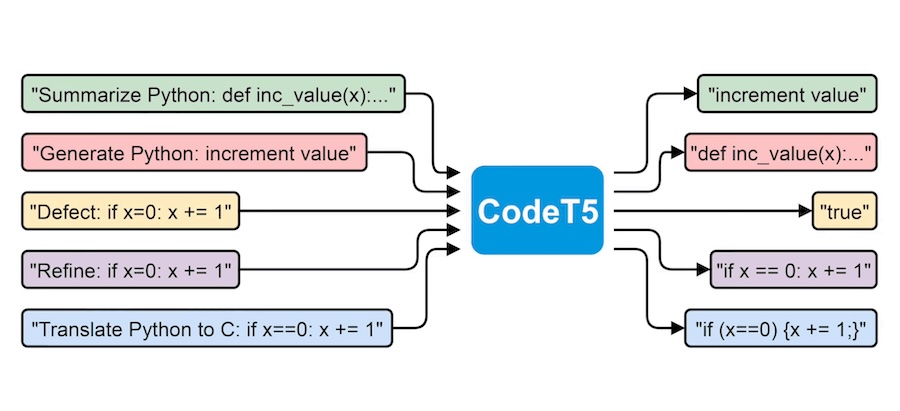
The tool excels at complex code transformations, including refactoring legacy code, translating between programming languages, and generating comprehensive documentation from code comments and structure. CodeT5’s ability to understand the intent behind code rather than just syntax patterns makes it particularly valuable for maintaining and modernizing large codebases. The tool can analyze code quality, suggest improvements, and even predict potential bugs before they occur.
CodeT5’s versatility makes it suitable for a wide range of development tasks, from automated testing and code review to educational applications and code analysis. Its open-source nature allows for extensive customization and integration into existing development workflows. The tool’s ability to handle both high-level architectural questions and low-level implementation details makes it valuable for developers at all skill levels. Its performance on benchmark tests for code understanding and generation consistently ranks among the top AI coding tools available.
11. DeepCode (now part of Snyk)
DeepCode, now integrated into Snyk’s security platform, represents a sophisticated approach to AI-powered code analysis and security scanning. This tool combines advanced static analysis with machine learning to identify potential bugs, security vulnerabilities, and code quality issues that traditional tools might miss. DeepCode’s strength lies in its ability to understand code context and detect complex issues that require semantic analysis rather than simple pattern matching.
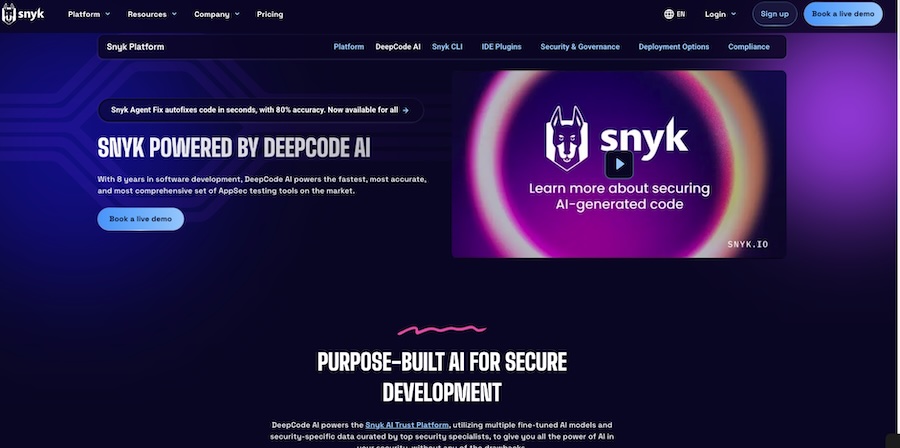
The platform analyzes code repositories to identify potential security vulnerabilities, performance bottlenecks, and maintainability issues. DeepCode’s AI models are trained on millions of commits and bug fixes, allowing them to recognize patterns that indicate potential problems. The tool provides detailed explanations for each issue it identifies, along with suggested fixes and best practices for preventing similar problems in the future.
Integration with development workflows is seamless, supporting pull request analysis, CI/CD pipeline integration, and real-time analysis as code is written. DeepCode’s ability to learn from a team’s specific coding patterns and historical issues makes its suggestions increasingly relevant over time. The tool’s focus on security and code quality makes it essential for teams developing applications that handle sensitive data or require high reliability. Its comprehensive reporting and analytics capabilities help development managers track code quality trends and make informed decisions about technical debt and security priorities.
12. Sourcery
Sourcery has carved out a unique niche as an AI-powered code review and refactoring tool that focuses specifically on improving code quality and maintainability. This tool automatically analyzes code during development and suggests improvements that enhance readability, performance, and adherence to best practices. Sourcery’s strength lies in its deep understanding of programming idioms and its ability to suggest refactoring that maintains functionality while improving code quality.
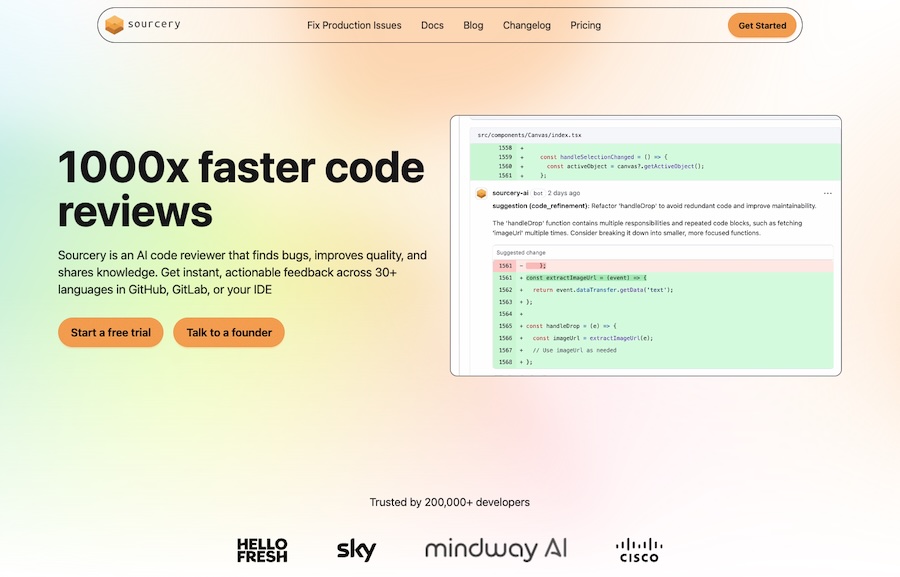
The tool excels at identifying opportunities for simplification, suggesting more efficient algorithms, and recommending modern programming patterns that replace outdated approaches. Sourcery’s suggestions are accompanied by detailed explanations of why the changes are beneficial, making it an educational tool that helps developers improve their coding skills over time. The tool’s integration with version control systems allows it to provide feedback during code review processes, helping maintain consistent code quality across teams.
Sourcery’s focus on incremental improvement means that it doesn’t overwhelm developers with extensive changes but instead suggests manageable improvements that can be implemented gradually. The tool’s ability to understand team-specific coding standards and adapt its suggestions accordingly makes it valuable for maintaining consistency across large development teams. Its support for multiple programming languages and integration with popular IDEs make it easy to incorporate into existing development workflows. The tool’s emphasis on explaining the rationale behind its suggestions helps developers learn and grow their expertise over time.
13. Mintlify
Mintlify has established itself as the leading AI-powered documentation generation tool, addressing one of the most neglected aspects of software development: creating and maintaining comprehensive documentation. The tool automatically generates documentation from code comments, function signatures, and code structure, creating professional-quality documentation that stays synchronized with code changes.
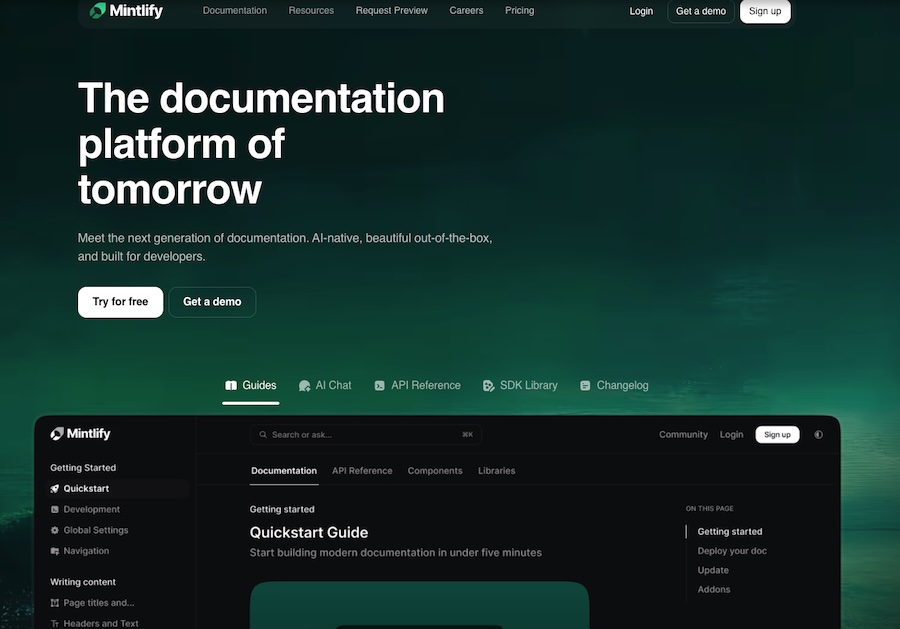
Mintlify’s strength lies in its ability to understand code intent and generate documentation that explains not just what code does, but why it does it and how it fits into the broader system architecture. The tool can generate API documentation, user guides, and technical specifications that are both comprehensive and accessible to different audiences. Its natural language processing capabilities allow it to create documentation that reads naturally while maintaining technical accuracy.
The platform’s integration with popular development workflows means that documentation updates automatically as code changes, eliminating the common problem of outdated documentation. Mintlify’s ability to generate different types of documentation for different audiences (developers, product managers, end users) makes it valuable for teams that need to communicate technical information to diverse stakeholders. Its customizable templates and styling options allow teams to maintain brand consistency while benefiting from automated documentation generation.
14. Pieces
Pieces represents an innovative approach to developer productivity by serving as an AI-powered code snippet manager and developer assistant. This tool addresses the common challenge of managing and reusing code snippets, boilerplate code, and development resources across projects and teams. Pieces uses AI to automatically categorize, tag, and make searchable all the code snippets and resources that developers save.
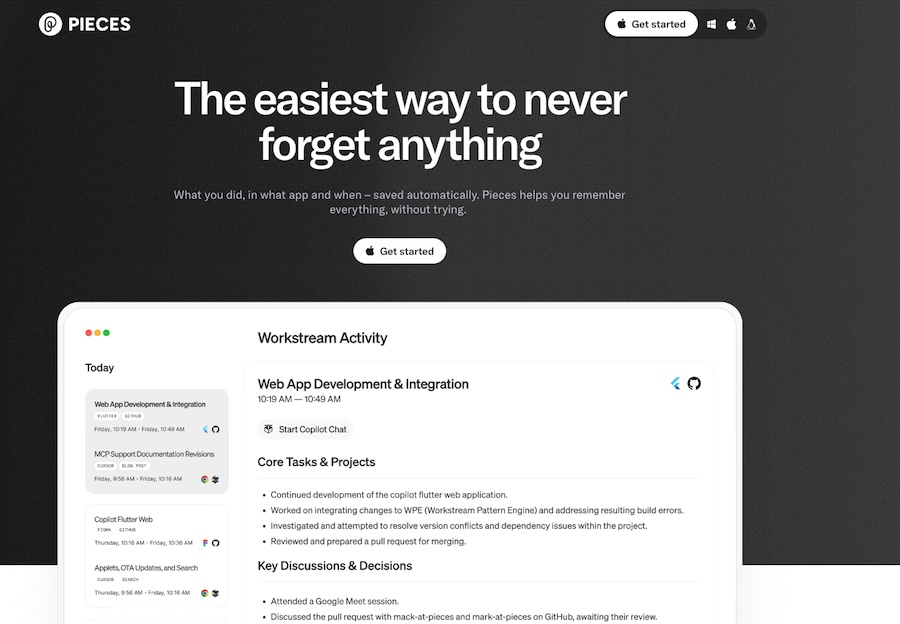
The platform’s AI capabilities extend beyond organization to include intelligent code generation based on saved snippets, automatic documentation of code fragments, and suggestions for reusable components. Pieces can understand the context in which code snippets are used and suggest relevant snippets when developers are working on similar problems. The tool’s ability to extract and save useful code from various sources (including screenshots of code) makes it invaluable for learning and reference purposes.
Pieces integrates seamlessly with existing development workflows, supporting all major IDEs and providing browser extensions for saving code from documentation sites, Stack Overflow, and other online resources. The tool’s collaborative features allow teams to share and discover useful code snippets and best practices. Its AI-powered search capabilities make it easy to find relevant code even with vague or partial descriptions. The tool’s focus on developer productivity and knowledge management makes it an essential part of modern development workflows.
15. IntelliCode
Microsoft’s IntelliCode brings sophisticated AI assistance directly into Visual Studio and Visual Studio Code, leveraging Microsoft’s extensive experience in developer tools and machine learning. This tool provides intelligent code completion suggestions based on analysis of thousands of open-source projects, helping developers write code that follows established patterns and best practices.
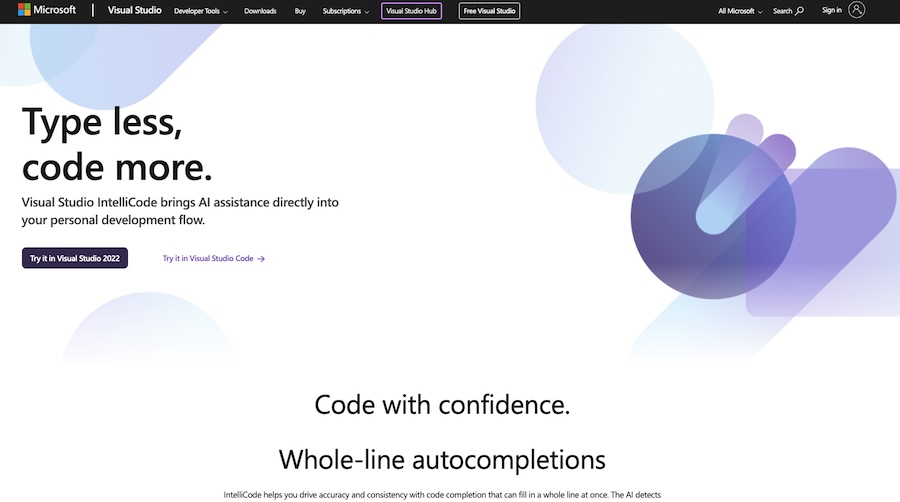
IntelliCode’s strength lies in its deep integration with Microsoft’s development ecosystem and its ability to provide contextually relevant suggestions that understand both immediate code context and broader project architecture. The tool can learn from a team’s specific coding patterns and conventions, providing increasingly relevant suggestions over time. Its ability to suggest entire methods and classes based on usage patterns makes it particularly valuable for maintaining consistency across large codebases.
The tool’s integration with Microsoft’s other developer services, including Azure DevOps and GitHub, provides additional context for code suggestions and helps maintain consistency across the entire development lifecycle. IntelliCode’s support for multiple programming languages and its ability to work with both traditional and modern development frameworks make it versatile for diverse development needs. Its focus on learning from real-world code patterns rather than theoretical examples helps ensure that suggestions are practical and production-ready.
16. OpenAI Codex
OpenAI Codex, the AI system that powers GitHub Copilot, represents one of the most significant breakthroughs in AI-powered code generation. While primarily accessed through tools like Copilot, understanding Codex’s capabilities helps developers appreciate the underlying technology that makes modern AI coding assistance possible. Codex’s ability to understand natural language descriptions and convert them into functional code across multiple programming languages demonstrated the potential of large language models for software development.
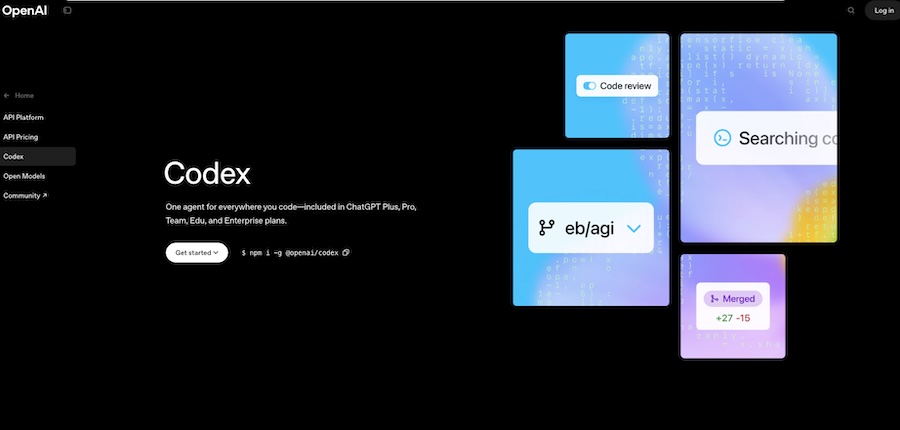
Codex’s training on billions of lines of code from public repositories gives it an unprecedented understanding of programming patterns, idioms, and best practices. The model’s ability to generate not just code snippets but entire functions and classes based on comments or natural language descriptions revolutionized how developers approach problem-solving and implementation.
The technical achievements of Codex, including its ability to work across programming languages and understand complex coding contexts, set the foundation for the current generation of AI coding tools. Developers working with any Codex-powered tool benefit from understanding its capabilities and limitations. The model’s approach to balancing creativity with correctness in code generation continues to influence the development of new AI coding assistants and shapes expectations for what these tools can accomplish.
Final Thoughts
AI tools are no longer just optional add-ons—they are becoming essential companions for modern developers. By automating repetitive coding tasks, providing real-time suggestions, and improving error detection, these tools help developers write cleaner, more efficient code while saving valuable time.
Beyond coding, AI-powered platforms also assist with project management, testing, debugging, and performance optimization, making the entire software development lifecycle smoother and more effective. Whether you are a solo developer working on small projects or part of a large development team, integrating AI tools into your workflow can significantly boost productivity and innovation.
As technology continues to evolve, these tools will only get smarter, offering even greater support for developers across different programming languages and environments. Embracing AI in development today ensures you stay ahead of the curve, building applications faster, with fewer mistakes, and with a greater focus on creativity and problem-solving.