Geeksdigit Team
Windows 11 includes several ways to access the Boot Menu, allowing you to start your PC from a USB drive, DVD, external hard drive, or another bootable device. The Boot Menu is especially useful when installing Windows, running recovery tools, updating the BIOS, or troubleshooting startup problems. Unlike changing the boot order permanently in BIOS or UEFI settings, the Boot Menu lets you choose a boot device for a single startup.
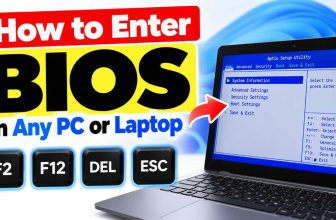
Depending on your computer’s manufacturer, the key used to open the Boot Menu varies. Common keys include F12, F11, F9, Esc, and F8. If you cannot access the Boot Menu using the keyboard during startup, Windows 11 also provides options to boot directly into UEFI firmware or advanced startup settings.
This guide explains the different methods to access the Boot Menu in Windows 11.
What Is the Boot Menu?
The Boot Menu is a temporary startup menu that appears before Windows loads. It allows you to select the device your computer should boot from without permanently changing the boot order in BIOS or UEFI.
You can use the Boot Menu to:
- Boot from a USB flash drive
- Start from a DVD or CD
- Launch a recovery drive
- Boot from another internal drive
- Run diagnostic tools
- Install or reinstall Windows 11
- Access some manufacturer recovery environments
Method 1: Use the Boot Menu Key During Startup
The quickest way to access the Boot Menu is by pressing the correct function key immediately after powering on your PC.
- Shut down your computer completely.
- Connect the bootable USB drive or other device if needed.
- Press the power button.
- Immediately begin pressing the Boot Menu key repeatedly.
- Wait for the Boot Menu to appear.
- Select the desired boot device using the arrow keys.
- Press Enter.
Common Boot Menu Keys
| Manufacturer | Boot Menu Key |
|---|---|
| Acer | F12 |
| ASUS | Esc or F8 |
| Dell | F12 |
| HP | Esc, then F9 |
| Lenovo | F12 or Fn + F12 |
| MSI | F11 |
| Samsung | Esc or F12 |
| Sony | Assist or F11 |
| Toshiba | F12 |
| Gigabyte | F12 |
| Intel NUC | F10 |
If one key does not work, restart the PC and try another supported key.
Method 2: Access Boot Options from Advanced Startup
Windows 11 allows you to enter advanced startup without using keyboard shortcuts.
- Open Settings.
- Select System.
- Click Recovery.
- Locate Advanced startup.
- Click Restart now.
- Confirm the restart.
- Select Use a device.
- Choose the bootable USB, DVD, or network device.
Windows will immediately restart using the selected boot device.
Method 3: Use the Shift + Restart Shortcut
You can quickly reach advanced startup directly from the Start menu.
- Open the Start menu.
- Click the Power button.
- Hold the Shift key.
- Select Restart.
- Continue holding Shift until Windows restarts.
- Select Use a device.
- Choose your boot device.
This method works even if Windows is functioning normally.
Method 4: Boot Into UEFI Firmware Settings
If you cannot open the Boot Menu, you can enter UEFI firmware settings instead.
- Open Settings.
- Go to System > Recovery.
- Click Restart now under Advanced startup.
- Select Troubleshoot.
- Click Advanced options.
- Choose UEFI Firmware Settings.
- Select Restart.
Your computer will restart directly into BIOS or UEFI setup, where you can modify boot settings if necessary.
Method 5: Use the Command Prompt
Advanced users can restart directly into Windows Recovery Environment.
- Open Command Prompt as administrator.
- Type the following command:
shutdown /r /o /f /t 0- Press Enter.
- Wait for the computer to restart.
- Select Use a device or access UEFI Firmware Settings.
This command immediately restarts Windows into the recovery environment.
Method 6: Access the Boot Menu Using Windows Recovery
If Windows fails to start normally several times, it usually enters Windows Recovery automatically.
- Turn on the PC.
- When the Windows logo appears, hold the power button to force shutdown.
- Repeat this process two or three times.
- Windows should display Preparing Automatic Repair.
- Select Advanced options.
- Choose Use a device if available or access UEFI Firmware Settings.
This method is useful when Windows cannot boot successfully.
Method 7: Use a Dedicated Recovery Button
Some laptops include a special recovery or Novo button.
- Shut down the computer.
- Press the recovery or Novo button using a paperclip if necessary.
- Wait for the recovery menu.
- Select Boot Menu.
- Choose the desired boot device.
This option is available only on supported systems.
Method 8: Disable Fast Startup
Fast Startup can sometimes prevent keyboard shortcuts from working during boot.
- Open Control Panel.
- Click Power Options.
- Select Choose what the power buttons do.
- Click Change settings that are currently unavailable.
- Uncheck Turn on fast startup.
- Click Save changes.
- Shut down the PC completely.
- Turn it back on and try the Boot Menu key again.
Disabling Fast Startup gives you more time to press the Boot Menu key.
Method 9: Use a USB Installation Drive
If your goal is to install Windows 11, prepare a bootable USB first.
- Insert the Windows installation USB.
- Restart the computer.
- Press the Boot Menu key repeatedly.
- Select the USB drive.
- Press Enter.
- Wait for Windows Setup to load.
You can now install or repair Windows.
Method 10: Change Boot Order in BIOS
If the Boot Menu is unavailable, changing the boot order is another option.
- Restart the computer.
- Enter BIOS or UEFI using the appropriate key.
- Open the Boot tab.
- Move the USB drive to the top of the boot order.
- Save the changes.
- Exit BIOS.
- The computer will boot from the selected device.
Remember to restore the original boot order afterward if needed.
Common Boot Menu Problems
Boot Menu Key Does Not Work
Possible solutions include:
- Press the key immediately after powering on.
- Shut down instead of restarting.
- Disable Fast Startup.
- Try another supported function key.
- Use a wired keyboard if using a desktop.
USB Drive Does Not Appear
Try these fixes:
- Recreate the bootable USB.
- Connect it to another USB port.
- Enable USB boot in BIOS.
- Verify the USB is bootable.
Computer Boots Directly into Windows
This usually happens when:
- The Boot Menu key was pressed too late.
- Fast Startup is enabled.
- The bootable device is not properly detected.
UEFI Firmware Option Is Missing
Some older computers use Legacy BIOS instead of UEFI, so this option may not be available.
Tips for Accessing the Boot Menu
For a smoother experience:
- Use a fully bootable USB drive.
- Connect external drives before turning on the PC.
- Learn your computer manufacturer’s Boot Menu key.
- Disable Fast Startup if keyboard shortcuts fail.
- Keep BIOS or UEFI firmware updated when recommended by your manufacturer.
Conclusion
The Boot Menu in Windows 11 provides a convenient way to temporarily boot from USB drives, DVDs, recovery media, or other storage devices without permanently changing your BIOS settings. The simplest method is pressing the correct Boot Menu key during startup, while Windows also offers Advanced Startup and UEFI Firmware Settings for systems where keyboard shortcuts do not work.
Whether you’re installing Windows 11, running diagnostics, or troubleshooting startup issues, these methods make accessing the Boot Menu straightforward on most modern PCs.
Frequently Asked Questions
What is the Boot Menu used for in Windows 11?
It lets you choose a device to boot from, such as a USB flash drive, DVD, external drive, or recovery media, for the current startup only.
What is the most common Boot Menu key?
Many PCs use F12, but other manufacturers may use Esc, F11, F9, or F8.
Can I access the Boot Menu without restarting?
No. The Boot Menu appears only during startup. However, you can use Advanced Startup in Windows to restart directly into boot options.
Is the Boot Menu different from BIOS?
Yes. The Boot Menu lets you temporarily choose a boot device for one startup, while BIOS or UEFI settings allow you to permanently configure the boot order and other firmware options.