Geeksdigit Team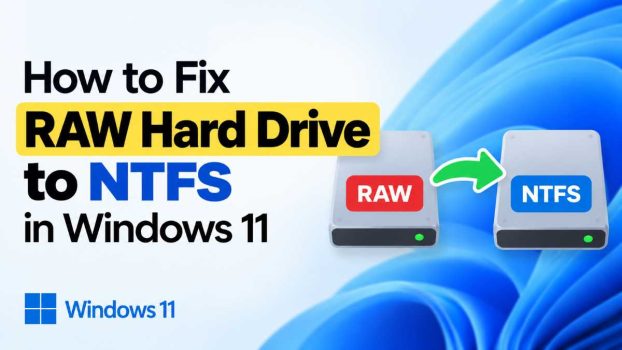
If you’ve ever plugged in an external hard drive or internal partition on your Windows 11 PC only to see an error like “You need to format the disk before you can use it,” you’ve run into the dreaded RAW file system problem. Instead of showing up as NTFS, FAT32, or exFAT, the drive appears as “RAW” — a state where Windows can detect the physical disk but can’t read its file system structure at all.
This isn’t a hardware failure in most cases. It’s a logical corruption issue, meaning the data is very likely still sitting on the drive; Windows simply can’t interpret the file system table that tells it where each file lives. The good news is that a RAW drive can almost always be converted back to NTFS, and in many cases your files can be recovered in the process.
In this guide, we’ll walk through why drives turn RAW in the first place, and then cover four practical methods to fix a RAW hard drive and restore it to NTFS in Windows 11 — from built-in Windows tools to third-party recovery software. We’ll wrap up with answers to the most common questions people have about RAW drives.
Why Does a Hard Drive Become RAW?
Before diving into fixes, it helps to understand the common causes, since this affects which method you should try first:
- Improper ejection — Removing a USB drive or external HDD without safely ejecting it can corrupt the file system table mid-write.
- Sudden power loss — A crash or power outage while the drive is being read or written to can leave the file system in an inconsistent state.
- File system corruption — Bad sectors, malware, or a failing drive controller can damage the Master File Table (MFT) or partition boot sector.
- Partition table damage — Errors during partitioning, resizing, or cloning operations can leave a partition unreadable.
- Virus or ransomware infection — Some malware specifically targets the boot sector or file system metadata.
- Physical wear on the drive — Aging mechanical drives can develop bad sectors that corrupt the file system over time.
Critically, in almost none of these scenarios is the actual stored data instantly destroyed — the file system’s “index” is what’s broken, not necessarily the files themselves. That’s why the very first rule when dealing with a RAW drive is: do not format it right away, and avoid writing new data to it, since that can overwrite recoverable files.
Method 1: Recover Your Files First (Before Any Repair)
This isn’t strictly a “fix,” but it’s the most important step, and it should come before anything else if the drive contains anything you care about.
When Windows shows a drive as RAW, formatting it is often the tempting “quick fix” Windows itself suggests. Don’t do this yet. Formatting rewrites the file system structure and can make previously recoverable files much harder or impossible to retrieve.
Steps:
- Do not open, format, or write any new files to the RAW drive.
- Use a reputable data recovery tool that can read RAW/raw-partition file systems (many recovery tools operate below the file system layer and can recover files even when Windows can’t see a proper file system).
- Scan the drive and recover important files to a different physical drive — never save recovered files back onto the RAW drive itself.
- Once your data is safely backed up elsewhere, proceed to one of the repair methods below to restore the drive to NTFS.
If the drive contains nothing important, or you’ve already secured a backup, you can skip straight to the technical fixes.
Method 2: Use CHKDSK to Repair the File System
CHKDSK (Check Disk) is a built-in Windows utility designed to scan a drive for file system errors and attempt to repair them without erasing data. It’s usually the first thing to try after backing up your files, since it works directly on the existing file system rather than replacing it.
Steps:
- Press Windows + S, type
cmd, right-click Command Prompt, and select Run as administrator. - In the Command Prompt window, type the following, replacing
Xwith your RAW drive’s letter:
chkdsk X: /f /r /x
- Press Enter and let the scan run. Depending on the drive’s size and condition, this can take anywhere from a few minutes to several hours.
- Once complete, open File Explorer and check whether the drive now shows up as NTFS with your files accessible.
What the switches mean:
/ffixes errors found on the disk./rlocates bad sectors and attempts to recover readable information from them./xforces the volume to dismount first if necessary, which can be required for drives in active use.
CHKDSK works well when the corruption is relatively minor — for example, an interrupted write or a few damaged sectors. It’s less effective if the partition boot sector or MFT is severely damaged, in which case you may see a message saying “the type of the file system is RAW” and CHKDSK will refuse to run at all. If that happens, move on to Method 3.
Method 3: Use DiskPart or a Partition Tool to Rebuild the File System
If CHKDSK can’t run or doesn’t resolve the issue, the next option is to work at the partition level using DiskPart, Windows’ built-in disk management command-line tool, or a third-party partition manager with a graphical interface.
Using DiskPart (advanced users):
- Open Command Prompt as administrator and type
diskpart. - Type
list diskto see all connected drives, thenselect disk X(replacing X with the correct disk number — double-check this carefully, as selecting the wrong disk risks data loss). - Type
list partitionto view partitions on that disk, thenselect partition Yfor the RAW partition. - Type
detail partitionto confirm you’ve selected the right one.
At this point, DiskPart itself won’t repair a RAW file system — it’s primarily for viewing and managing partitions. If the partition structure looks intact but the file system flag reads RAW, you have two realistic paths:
- Reformat as NTFS (only after recovering your data):
format fs=ntfs quick— this creates a fresh NTFS file system on the partition, making it usable again, but it does erase whatever remains on the drive. - Use a third-party partition recovery tool (recommended if you haven’t recovered data yet) such as MiniTool Partition Wizard, EaseUS Partition Master, or similar software. These tools can often rebuild a damaged partition table or MFT without a full format, which sometimes restores both the NTFS file system and your original data simultaneously.
For most home users, a graphical partition tool is safer than raw DiskPart commands, since it reduces the risk of selecting the wrong disk.
Method 4: Format the Drive to NTFS (Last Resort)
If the earlier methods don’t restore the drive, or if you’ve already recovered your important files and simply want the drive usable again, formatting is the most reliable way to convert it back to NTFS.
Steps using File Explorer:
- Open File Explorer and locate the RAW drive under This PC.
- Right-click the drive and select Format.
- In the File system dropdown, choose NTFS.
- Leave “Quick Format” checked for a faster process (uncheck it only if you suspect bad sectors and want a full scan, which takes much longer).
- Click Start, confirm the warning, and wait for the process to complete.
Steps using Disk Management (if the drive doesn’t appear in File Explorer):
- Right-click the Start button and select Disk Management.
- Locate the RAW drive (it will typically be labeled “RAW” in the file system column).
- Right-click the partition and choose Format.
- Select NTFS, assign a volume label if desired, and click OK.
Once formatting completes, the drive will show up as healthy NTFS storage in File Explorer. Keep in mind this method erases all data on the partition — it should only be used after you’ve confirmed your important files are safely recovered, or when the drive never contained data you need.
Conclusion
A RAW hard drive looks alarming, but it’s rarely a sign that your data is permanently gone — it usually means the file system’s internal map is corrupted, not that the files themselves have been erased. The safest path is always to recover your data first, then repair the drive: start with CHKDSK for a quick, non-destructive fix, escalate to partition-level tools if the corruption is deeper, and treat a full NTFS format as your last resort once your files are safely backed up elsewhere.
If you regularly encounter RAW drives, it’s worth investigating the root cause — whether that’s an aging drive with growing bad sectors, a habit of unsafe removal, or unstable power delivery to an external enclosure — since fixing the underlying issue will save you from repeating this process down the road.
Frequently Asked Questions
1. Will I lose my files if a drive shows as RAW? Not necessarily. In most RAW drive cases, the actual data remains physically intact on the disk; only the file system’s index is corrupted, so Windows can’t display or access the files properly. Using a data recovery tool before repairing or formatting the drive gives you the best chance of getting your files back.
2. Should I format a RAW drive immediately when Windows suggests it? No. Formatting rewrites the file system structure and can overwrite the data pointers needed for recovery. Always attempt recovery first, and only format after your files are safely backed up or if the drive never held important data.
3. Why does CHKDSK say it can’t check a RAW drive? CHKDSK relies on an existing, at least partially readable file system to perform repairs. If the corruption is severe enough that Windows can’t identify any file system structure at all, CHKDSK will refuse to run, and you’ll need a partition recovery tool or a full format instead.
4. Can a RAW drive be a sign of failing hardware? Sometimes. While most RAW errors stem from logical corruption (bad shutdowns, improper ejection, software glitches), a drive that repeatedly turns RAW after being repaired can indicate developing bad sectors or a failing drive. Running a full disk health check (via manufacturer tools or chkdsk /r) can help you determine whether it’s time to replace the drive.