Geeksdigit Team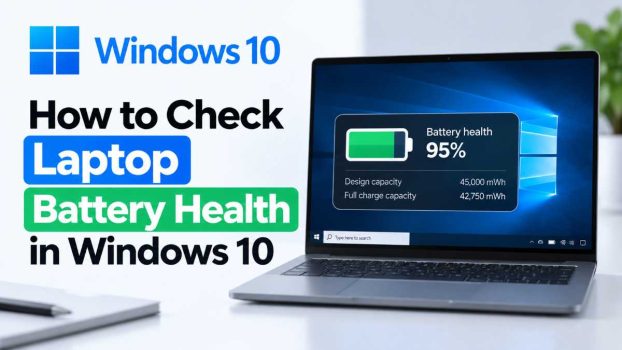
Every laptop battery has a lifespan, and that lifespan is measured not just in years but in charge cycles. Over time, a lithium-ion battery’s ability to hold a charge gradually declines. A battery that once gave you eight hours of use might now barely last four, even though the laptop itself feels perfectly fine otherwise. This kind of wear is normal, but it can sneak up on you if you’re not paying attention.
The good news is that Windows 10 comes with a built-in tool that lets you check exactly how healthy your battery is, without installing any third-party software. This tool generates a detailed report showing your battery’s design capacity, its current full-charge capacity, its usage history, and even an estimate of how much longer it might last on a single charge. Knowing this information can help you decide whether it’s time to change your habits, recalibrate your battery, or start shopping for a replacement.

In this guide, we’ll walk through the exact steps to check your laptop’s battery health in Windows 10, explain what the resulting report actually means, and answer some of the most common questions people have about battery health and longevity. Whether you’re troubleshooting a laptop that seems to drain faster than it used to, or you’re just curious about the state of your hardware, this guide will give you a clear, actionable path forward.
Method: Using the Built-In Battery Report Tool
Windows 10 includes a hidden but powerful diagnostic feature called the “Battery Report.” It’s accessed through the Command Prompt and generates an HTML file packed with data about your battery’s performance over time. Here’s how to generate and read it.
Step 1: Open Command Prompt
You don’t need administrator privileges to run this command, though running as administrator is fine too if that’s your default habit.
- Click the Start button or press the Windows key.
- Type cmd into the search bar.
- When “Command Prompt” appears in the results, click it to open a standard command window. You can also right-click and choose “Run as administrator” if you prefer, though it isn’t strictly required for this particular command.
Alternatively, you can press Windows + R to open the Run dialog, type cmd, and press Enter.
Step 2: Run the Battery Report Command
In the Command Prompt window, type the following command exactly as written, then press Enter:
powercfg /batteryreportWindows will process this almost instantly and respond with a message telling you where the report has been saved. By default, it’s saved as an HTML file in the current user directory, typically something like:
C:\Users\YourUsername\battery-report.htmlThe exact path will be printed directly in the Command Prompt window, so you don’t need to guess. It usually looks like this: “Battery life report saved to file path C:\Users\YourUsername\battery-report.html.”
If you’d like the report saved somewhere more convenient, such as your Desktop, you can specify a custom output path by adding the /output flag followed by the desired file location, for example:
powercfg /batteryreport /output "C:\Users\YourUsername\Desktop\battery-report.html"Step 3: Open the Report
Navigate to the file location shown in the Command Prompt, then double-click the battery-report.html file. It will open automatically in your default web browser, since it’s formatted as a simple webpage rather than a proprietary file type.
Step 4: Understand What You’re Looking At
The report is broken into several sections, and each one tells a different part of the story about your battery’s health.
Installed batteries — This section lists basic information about your battery, including its manufacturer, chemistry (usually Lithium-ion), and serial number if available.
Recent usage — This table shows how your laptop has been used over roughly the past three days, broken down by hour. It notes whether the device was active, connected to AC power, or in sleep or off states, along with the battery charge level at each point. This is useful for spotting unusual drain patterns, like the battery dropping quickly even while the laptop was supposedly idle.
Battery usage — A visual chart plotting charge level over the same recent period, giving you an at-a-glance view of charging and discharging cycles.
Usage history — This extends further back, often weeks or months, showing active and standby runtime on a daily or weekly basis.
Battery capacity history — This is one of the most important sections for judging battery health. It shows the “full charge capacity” of your battery at different points over time, compared against the original design capacity. If you see this number steadily shrinking over the months, that’s a clear sign of battery aging.
Battery life estimates — This is the section most people care about most. It compares the estimated battery life “at design capacity” (what the manufacturer originally promised) against the estimated battery life “at full charge capacity” (what your battery can realistically deliver right now, given its current wear). The gap between these two numbers tells you how much capacity you’ve actually lost.
Step 5: Do the Math
The most telling number in the entire report is the ratio between your battery’s current full charge capacity and its original design capacity. For example, if your laptop’s battery was designed to hold 50,000 mWh but now only holds 38,000 mWh at full charge, you’ve lost roughly 24% of its original capacity. Occasional loss of 10 to 20% within the first year or two is considered normal wear. If you’re seeing losses beyond 30 to 40%, especially in a laptop only two or three years old, your battery is likely due for replacement, or at least a change in charging habits.
Alternative Method: Check Battery Status via Settings
If you just want a quick overview without generating a full report, Windows 10 also lets you glance at basic battery information through Settings, though this method is far less detailed:
- Go to Settings > System > Battery.
- Here you can see your battery percentage over the past 24 hours or 7 days, along with which apps are consuming the most power.
This won’t give you capacity or health data the way the battery report does, but it’s a useful supplementary tool for spotting apps that drain your battery unusually fast.
Conclusion
Checking your laptop’s battery health doesn’t require any special software or technical expertise. Windows 10’s built-in powercfg /batteryreport command gives you a comprehensive, easy-to-read breakdown of your battery’s design capacity, current capacity, and usage patterns, all in a matter of seconds. By comparing your battery’s current full-charge capacity against its original design capacity, you can get a clear, objective sense of how much life your battery has lost and whether it’s time to consider a replacement.
Regularly checking this report every few months can help you catch problems early, before they turn into a laptop that suddenly can’t hold a charge at all. It also helps set realistic expectations: batteries degrade naturally over time, and understanding that degradation curve means you won’t be caught off guard when your once all-day battery starts needing a midday top-up.
If your report reveals significant capacity loss, there are steps you can take to slow further degradation, such as avoiding letting the battery sit at 0% or 100% for extended periods, keeping the laptop out of extreme heat, and using battery saver modes when you don’t need full performance. But if the damage is already done and the numbers are too low to ignore, it may simply be time to have the battery replaced by a professional or, if your laptop model supports it, do it yourself with a manufacturer-approved replacement battery.
Frequently Asked Questions
1. How often should I check my laptop’s battery health?
There’s no strict rule, but checking every two to three months is a reasonable habit for most users. If you rely heavily on your laptop for work or travel and need to trust its battery life estimates, checking monthly can help you catch a decline early. There’s no harm in checking more frequently since generating the report takes only a few seconds and doesn’t affect the battery itself.
2. What counts as “normal” battery degradation?
Most lithium-ion batteries are rated for somewhere between 300 and 1,000 full charge cycles before capacity drops meaningfully, often defined as retaining around 80% of original capacity. Losing 10 to 20% of capacity within the first one to two years of regular use is considered typical wear and not a cause for concern. If you’re seeing 30% or more loss well before that timeframe, especially alongside symptoms like rapid draining or the laptop shutting down unexpectedly at higher percentages, it may indicate a more serious issue worth investigating or having the battery serviced.
3. Can I improve my battery health after running the report?
You can’t undo existing wear, since capacity loss in lithium-ion batteries is generally irreversible, but you can slow future degradation. Best practices include avoiding extreme temperatures, not leaving your laptop plugged in at 100% for prolonged periods, avoiding letting the battery drain completely to 0% regularly, and using Windows’ built-in battery saver settings. Some laptop manufacturers also offer their own battery care software with features like charge limiting, which caps the battery at 80% to reduce long-term stress.
4. Does the battery report work on all Windows 10 laptops, or only certain brands?
The powercfg /batteryreport command is a native Windows feature, not something tied to a specific manufacturer, so it works on virtually any Windows 10 laptop with a battery, whether it’s a Dell, HP, Lenovo, Asus, or any other brand. The only requirement is that the device actually reports battery information to the operating system, which is standard on essentially all modern laptops. If the report shows no battery detected or incomplete data, it usually points to a hardware or driver issue rather than a limitation of the tool itself.




![How to Boot into Windows 11 Safe Mode [5 Easy Methods]](https://www.geeksdigit.com/wp-content/uploads/2026/09/How-to-Boot-into-Windows-11-Safe-Mode-336x220.jpg)