Geeksdigit Team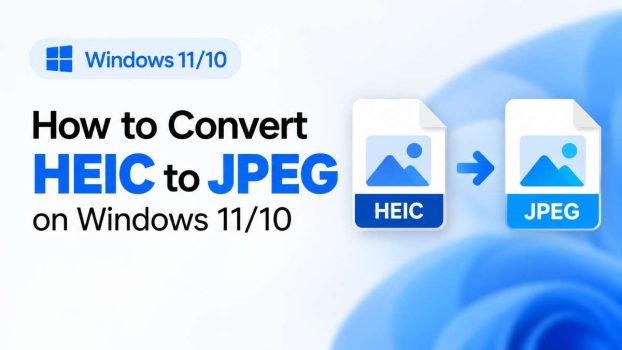
If you’ve ever transferred photos from an iPhone to a Windows PC, you’ve probably run into files ending in .HEIC that refuse to open properly, or that look like blank thumbnails in File Explorer. HEIC (High Efficiency Image Container) is Apple’s default photo format, and while it saves space and preserves quality beautifully, it’s not universally supported outside the Apple ecosystem. Most Windows apps, websites, and older software still expect the more familiar JPEG format.
The good news is that converting HEIC to JPEG on Windows 11 or Windows 10 is straightforward, and you have several options depending on how many files you need to convert, whether you want to work offline, and how much control you want over image quality. This guide walks through the most reliable methods, from built-in Windows tools to third-party apps and online converters, followed by a quick FAQ to clear up common questions.
Why HEIC Files Cause Problems on Windows

Before diving into the fixes, it helps to understand the issue. HEIC uses a modern compression standard (HEVC) that produces smaller files with the same visual quality as JPEG. Apple adopted it as the default photo format starting with iOS 11. Windows, however, doesn’t include native HEIC support out of the box — you need an extension or converter to view, edit, or share these files smoothly with people or programs that expect JPEG or PNG.
Converting to JPEG solves compatibility issues with:
- Older software and printers
- Websites and content management systems that reject HEIC uploads
- Email attachments that some clients won’t preview
- Video editors and design tools with limited format support
Method 1: Use the Microsoft Store HEIF Extension + Photos App
The simplest fix, especially if you only need to view and occasionally convert files, is installing Microsoft’s official HEIF extension.
- Open the Microsoft Store and search for “HEIF Image Extensions” (and, if prompted, “HEVC Video Extensions”).
- Install the free extension. This lets Windows generate thumbnails and open HEIC files natively in the Photos app.
- Open the HEIC file in the Photos app.
- Click the three-dot menu and select Save as, or use Edit & Create > Save a copy.
- Choose JPEG (.jpg) as the file type and save it to your desired folder.
This method works well for single files or small batches, and it’s entirely free and built into Windows once the extension is installed. The downside is that it’s not designed for bulk conversion — doing dozens or hundreds of images one at a time gets tedious fast.
Method 2: Batch Convert with Paint (Windows 11)
Windows 11’s updated Paint app can open and export HEIC files directly, provided the HEIF extension mentioned above is installed. While Paint doesn’t support true batch processing, it’s a handy no-install option for occasional conversions:
- Right-click a HEIC file and choose Open with > Paint.
- Once the image loads, go to File > Save as.
- Select JPEG picture from the format list.
- Rename if needed and save.
For anyone converting more than a handful of images, though, a dedicated batch tool will save considerable time.
Method 3: Bulk Convert Using File Explorer and PowerToys
If you’re comfortable with a slightly more technical approach, Microsoft’s PowerToys utility (free and open-source) includes an Image Resizer and, through community extensions, image conversion capabilities that integrate directly into the right-click context menu in File Explorer.
- Download and install PowerToys from the official Microsoft GitHub page or the Microsoft Store.
- Enable the relevant image utilities in PowerToys settings.
- Select multiple HEIC files in File Explorer, right-click, and look for a convert to or resize images option depending on which modules you’ve enabled.
- Set the output format to JPEG and confirm.
This route is ideal for power users who convert images regularly and want the process integrated into their normal workflow, without opening a separate app each time.
Method 4: Third-Party Desktop Converters
For heavy-duty batch conversion — think hundreds of photos from an iPhone backup — dedicated conversion software is usually the fastest and most reliable route. Popular options include:
- CopyTrans HEIC for Windows: Adds HEIC thumbnail support and a simple batch-convert-to-JPEG feature via right-click.
- iMazing HEIC Converter: A free, lightweight tool built specifically for drag-and-drop batch conversion, with adjustable JPEG quality settings.
- XnConvert or IrfanView (with the HEIC plugin): General-purpose image converters that handle HEIC alongside dozens of other formats, useful if you regularly convert mixed file types.
The general workflow across these tools is similar:
- Install the converter and any required plugin.
- Drag your HEIC files (or an entire folder) into the app window.
- Select JPEG as the output format and, if available, set a quality/compression level.
- Choose an output folder and start the conversion.
These tools typically process large batches in seconds and give you more control over compression quality, resizing, and output naming than the built-in Windows options.
Method 5: Online Converters (No Installation Needed)
If you’d rather not install anything, or you’re on a computer that isn’t yours, online converters are a quick alternative. Sites like CloudConvert, Convertio, and iLoveIMG let you upload HEIC files and download JPEG versions in your browser.
- Go to a reputable HEIC-to-JPEG converter website.
- Upload your HEIC file(s) — most sites support drag-and-drop and multiple files.
- Select JPEG as the output format.
- Download the converted files individually or as a ZIP archive.
The trade-off is that you’re uploading personal photos to a third-party server, which isn’t ideal for sensitive or private images, and large batches can be slow depending on your internet connection and the site’s file size limits. For occasional, non-sensitive conversions, though, it’s a genuinely convenient option that requires zero setup.
Which Method Should You Use?
- Converting just one or two photos? Use the Photos app or Paint with the free HEIF extension.
- Converting dozens or hundreds of photos regularly? Install a dedicated converter like CopyTrans or iMazing HEIC Converter, or set up PowerToys for right-click conversion.
- On a shared or public computer, or don’t want to install software? Use a trusted online converter, keeping privacy considerations in mind.
- Want more control over image quality and compression? Third-party desktop tools generally offer the most flexibility.
Conclusion
HEIC is a great format for saving storage space on your iPhone, but it isn’t always practical once those photos land on a Windows PC. Fortunately, converting HEIC to JPEG on Windows 11 or 10 doesn’t require much effort. For occasional use, Microsoft’s free HEIF extension paired with the Photos app or Paint gets the job done. For frequent or bulk conversions, a dedicated tool like iMazing HEIC Converter or CopyTrans will save you significant time, and PowerToys is a great option if you want conversion built right into File Explorer. Whichever method you choose, you’ll end up with JPEG files that open, share, and print without a hitch on virtually any device or platform.
FAQ
1. Does converting HEIC to JPEG reduce image quality? There is some quality loss, since JPEG uses different compression than HEIC, but at high quality settings (90% or above), the difference is generally invisible to the naked eye. If preserving maximum quality matters, choose a converter that lets you set the JPEG quality level manually rather than using default compression.
2. Why can’t Windows open HEIC files by default? HEIC relies on licensed HEVC codec technology, which Microsoft doesn’t bundle into Windows for licensing reasons. Instead, it offers the HEIF Image Extensions and HEVC Video Extensions as separate downloads (usually free, though the HEVC one occasionally requires a small fee) through the Microsoft Store.
3. Can I convert HEIC to JPEG without installing anything? Yes. Online converter websites let you upload HEIC files and download JPEG versions directly in your browser, with no software installation required. Just be mindful of uploading private or sensitive photos to third-party servers.
4. Can I change my iPhone’s camera settings so it stops saving photos as HEIC? Yes — on your iPhone, go to Settings > Camera > Formats and select Most Compatible instead of High Efficiency. This makes your iPhone capture new photos directly in JPEG, avoiding the need for conversion altogether, though the files will be somewhat larger.