Geeksdigit Team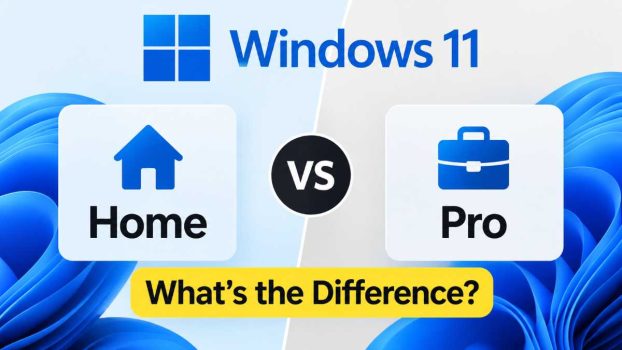
If you’re buying a new laptop or building a PC in 2026, you’ll run into the same fork in the road every Windows 11 shopper faces: Home or Pro? The two editions look identical on the surface — same Start menu, same taskbar, same gaming performance — but underneath, Microsoft has locked several business and security features behind the Pro edition’s higher price tag.
This guide breaks down every meaningful difference between Windows 11 Home and Windows 11 Pro, including pricing, security tools, virtualization, remote access, and device management, so you can decide which edition actually matches how you use your computer.
Windows 11 Pro vs Home: Quick Answer

If you just want the short version: Windows 11 Home is built for everyday users, students, and gamers, while Windows 11 Pro is built for professionals, small businesses, and IT-managed environments. Both run on the identical Windows kernel and deliver the same day-to-day performance, gaming compatibility, and visual experience. The gap only appears once you need encryption, remote access, virtualization, or centralized device management.
Buy Home if you browse, stream, game, and use Office apps. Buy Pro if you encrypt drives, host Remote Desktop sessions, run virtual machines, join a company domain, or manage multiple devices with Group Policy.
What Windows 11 Home and Pro Have in Common
Before diving into the differences, it’s worth underlining just how much the two editions share. Both editions ship with the same modern interface — centered Start menu, rounded corners, Snap Layouts, and redesigned widgets — along with full support for DirectX 12 Ultimate, Auto HDR, DirectStorage, and Xbox Game Pass integration. Windows Hello, TPM 2.0 requirements, Secure Boot, and Microsoft Defender are present in both editions as well, alongside built-in Microsoft Teams integration and Copilot.
Gamers in particular don’t lose anything by choosing Home. There is no frame-rate difference, no compatibility gap, and no missing DirectX feature between the two editions — the differences are entirely about business, security, and IT-management functionality, not gaming or general performance.
Windows 11 Pro vs Home: Feature Comparison Table
| Feature | Windows 11 Home | Windows 11 Pro |
|---|---|---|
| Price (list) | ~$139 | ~$199 |
| Start menu, Snap Layouts, widgets | Yes | Yes |
| DirectX 12 Ultimate, Auto HDR, DirectStorage | Yes | Yes |
| Windows Hello, Secure Boot, Defender | Yes | Yes |
| Device encryption (basic) | Yes (Microsoft account required) | Yes |
| Full BitLocker drive encryption | No | Yes |
| BitLocker To Go (USB encryption) | No | Yes |
| Remote Desktop (client) | Yes | Yes |
| Remote Desktop (host) | No | Yes |
| Hyper-V virtualization | No | Yes |
| Domain join / Active Directory | No | Yes |
| Group Policy Editor | No | Yes |
| Azure Active Directory / Entra ID join | No | Yes |
| Windows Information Protection | No | Yes |
| Assigned Access (kiosk mode) | No | Yes |
| Maximum RAM supported | 128 GB | 2 TB |
| Local account setup path | Restricted | Available |
1. Price: How Much More Does Pro Cost?
Windows 11 Home typically retails around $139, while Windows 11 Pro sits at roughly $199 — a gap of about $60. If you buy Home first and later decide you need Pro, Microsoft lets you upgrade in place through Settings for about $99, which means switching later costs more in total than buying Pro outright. For most manufacturers, this same price gap carries over to pre-built laptops and desktops, where Pro-equipped machines usually cost more than otherwise identical Home models.
If there’s any chance you’ll need a Pro-only feature — even one you’re not using yet — it’s cheaper to buy Pro from the start rather than upgrade down the line.
2. Security and Encryption: BitLocker vs Device Encryption
This is one of the most practical differences for everyday users. Windows 11 Home includes a scaled-down version called Device Encryption, which only activates automatically on supported hardware and generally requires a Microsoft account to manage the recovery key.
Windows 11 Pro includes full BitLocker encryption, which works on any drive — not just the system drive — and gives you direct control over encryption policy and recovery keys without being tied to a Microsoft account. Pro also includes BitLocker To Go, which extends the same encryption to external and USB drives. If your laptop travels with sensitive files, client data, or financial records, this single feature is often reason enough to choose Pro.
3. Remote Desktop: Client vs Host
Both editions can act as a Remote Desktop client, meaning you can connect out to another PC from a Home or Pro machine. The difference is in hosting: only Windows 11 Pro can act as a Remote Desktop host, letting other devices connect into it. This matters if you want to access your desktop PC from a laptop while traveling, or if you need to remotely support a machine for work. Home users who need inbound remote access typically have to rely on third-party tools instead.
4. Hyper-V and Virtual Machines
Windows 11 Pro includes Hyper-V, Microsoft’s built-in hypervisor, which lets you run one or more virtual machines directly on your PC without installing separate virtualization software. This is especially useful for developers testing across different operating systems, IT professionals sandboxing untrusted software, or anyone who needs to run legacy applications in an isolated environment.
Windows 11 Home does not include Hyper-V. Home users who need virtualization generally have to turn to third-party alternatives, which typically offer less integration with the rest of the Windows ecosystem.
5. Domain Join, Group Policy, and Business Management
For organizations, the biggest divide between the two editions is manageability. Windows 11 Pro can join a Windows Server domain or Microsoft Entra ID (formerly Azure Active Directory), letting IT departments centrally manage security policies, software deployment, and user permissions across many machines at once. Pro also unlocks the Group Policy Editor, giving administrators granular control over settings, restrictions, and configurations.
Windows 11 Home cannot join a domain and has no Group Policy Editor, which means it also can’t be centrally managed the same way. For a solo user or a single-device household, this limitation is irrelevant. For a business with more than a handful of devices, standardizing on Home creates inconsistent configurations, messier onboarding, and a security policy that’s harder to enforce across the fleet.
6. RAM Limits: 128 GB vs 2 TB
Windows 11 Home supports up to 128 GB of RAM, which is more than enough for the overwhelming majority of consumer and gaming setups. Windows 11 Pro raises that ceiling to 2 TB, a limit aimed squarely at workstations running memory-intensive workloads such as large-scale data analysis, video production, or virtualization hosting multiple VMs simultaneously. Unless you’re specifically building a high-end workstation, this difference won’t affect you — most consumer motherboards don’t support anywhere near 128 GB anyway.
7. Local Accounts vs Microsoft Accounts
During setup, Windows 11 Home pushes users fairly hard toward signing in with a Microsoft account, and the local-account workaround has become progressively harder to find with each Windows update. Windows 11 Pro still offers a more straightforward path to a local account during setup, which is a quiet but genuinely popular reason some users choose Pro even without needing any of its business features. If you prefer to keep your PC login separate from your Microsoft account, Pro currently makes that easier.
Who Should Buy Windows 11 Home?
Windows 11 Home is the right choice if:
- You use your PC mainly for browsing, streaming, gaming, or schoolwork.
- You don’t need to encrypt an entire drive or manage BitLocker keys manually.
- You’re not connecting to a company network or domain.
- You don’t need to run virtual machines.
- You want to save $60 or more compared to Pro.
For the vast majority of personal and family computers, Home covers everything you’ll ever touch. Gamers especially lose nothing by choosing it, since gaming performance, DirectX support, and driver compatibility are identical across both editions.
Who Should Buy Windows 11 Pro?
Windows 11 Pro makes sense if any of the following apply:
- You need full-disk encryption with BitLocker, particularly for compliance requirements like HIPAA or GDPR.
- You want to host Remote Desktop sessions so others (or you) can connect into this PC remotely.
- You develop software or test across multiple operating systems using Hyper-V.
- You need to join a company domain or Microsoft Entra ID.
- You manage multiple devices and want Group Policy control.
- You’re configuring a workstation that needs more than 128 GB of RAM.
- You simply want a straightforward local-account setup without pressure to use a Microsoft account.
Small businesses in particular tend to benefit from standardizing on Pro across all devices, even ones that don’t immediately need every feature. The consistency in security policy and management tooling tends to pay for itself once you’re supporting more than two or three machines.
Does Windows 11 Pro Perform Better Than Home?
No. This is one of the most common misconceptions about the two editions. Windows 11 Home and Pro run on the same underlying kernel, use the same drivers, and receive the same Windows Update cadence. There is no speed difference, no frame-rate difference, and no gaming compatibility gap between the two. The price difference reflects access to business, security, and management features — not raw performance.
Windows 11 Pro vs Home: Frequently Asked Questions
Can I upgrade from Windows 11 Home to Pro without reinstalling? Yes. Microsoft allows an in-place upgrade through Settings → System → Activation, which preserves your files, apps, and settings. You’ll need a Pro product key or an upgrade purchased through the Microsoft Store.
Is Windows 11 Pro worth it for gaming? Not specifically. Since gaming performance and compatibility are identical between editions, Pro is only “worth it” for gamers if they also need one of its business or security features, like BitLocker or Hyper-V for testing setups.
Does Windows 11 Home support external monitors, printers, and standard hardware the same as Pro? Yes. General hardware and peripheral support is identical across editions; the differences are limited to the features outlined above.
Can Windows 11 Home join a Wi-Fi network at a business? Yes — joining a Wi-Fi network is unrelated to domain join. Home can connect to any network; it simply can’t be managed via Group Policy or joined to a Windows domain/Entra ID for centralized administration.
Which edition do most new laptops ship with? Consumer and gaming laptops overwhelmingly ship with Home by default, while laptops marketed toward business or professional use typically ship with Pro pre-installed.
Final Verdict: Windows 11 Pro vs Home
For most people, Windows 11 Home is the smarter buy — it delivers the same core experience, the same gaming performance, and the same day-to-day usability as Pro, at a lower price. Windows 11 Pro earns its premium only when you specifically need BitLocker encryption, Remote Desktop hosting, Hyper-V virtualization, domain join, or centralized device management through Group Policy.
If you’re on the fence and think there’s even a chance you’ll need one of Pro’s business features down the road, it’s cheaper to buy Pro upfront than to upgrade later. Otherwise, save the money, stick with Home, and put the difference toward more RAM or storage instead.


![How to Boot into Windows 11 Safe Mode [5 Easy Methods]](https://www.geeksdigit.com/wp-content/uploads/2026/09/How-to-Boot-into-Windows-11-Safe-Mode-336x220.jpg)