Geeksdigit Team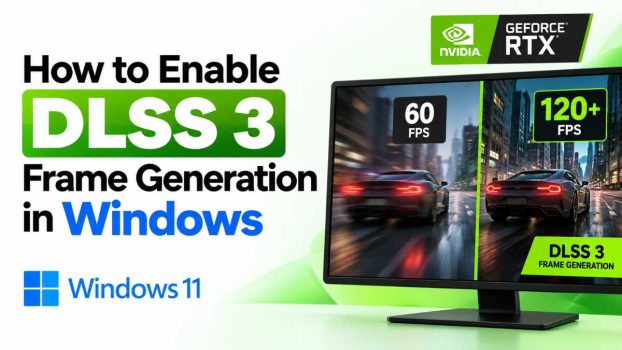
NVIDIA’s DLSS 3 Frame Generation is one of the most dramatic performance features to land on GeForce GPUs in recent years. Unlike traditional DLSS upscaling, which renders a frame at a lower resolution and uses AI to reconstruct it at higher resolution, Frame Generation goes a step further: it uses an AI model to analyze the current rendered frame and generate an entirely new frame that is inserted between two traditionally rendered frames, effectively boosting your displayed frame rate without the GPU having to fully render every single frame. NVIDIA has claimed this can deliver up to a 4x increase in frame rate compared to non-DLSS rendering methods in supported titles.
This guide walks through everything you need — hardware requirements, driver setup, Windows-specific configuration, in-game steps, and troubleshooting — to get Frame Generation working properly on your system.
What DLSS 3 Frame Generation Actually Does
To understand why setup matters, it helps to understand the tech. DLSS 3 Frame Generation works by taking two sequential frames rendered by the game engine, calculating optical flow and motion vector data for every object on screen, and then feeding that data into a neural network trained specifically for this task. The network uses this information to synthesize a brand-new, fully rendered-looking frame that sits between the two real frames. The result is a smoother-looking, higher frame-rate image, even though the GPU is doing less “traditional” rendering work per visible frame.
This process relies on a piece of dedicated hardware called the Optical Flow Accelerator, which calculates the motion vectors needed to generate an accurate in-between frame. That’s the key reason Frame Generation isn’t a simple software toggle available to everyone — it depends on silicon that only exists in newer GPUs.
Hardware and Software Requirements
Before touching any settings, confirm your system actually meets the requirements. This is the step most people get tripped up on, because DLSS itself (the upscaling part) works on older RTX 20- and 30-series cards, but Frame Generation does not.
GPU: You need an NVIDIA GeForce RTX 40-series card (or newer, including RTX 50-series cards, which support it alongside the newer DLSS 4 Multi Frame Generation). This includes cards from the RTX 4060 up through the RTX 4090, as well as their Ti and Super variants. Frame Generation is tied specifically to this hardware, unlike DLSS Super Resolution (the upscaling component), which works across all RTX generations. If you’re running an RTX 3080, 3070, or any 20-series card, standard DLSS upscaling and NVIDIA Reflex will work fine, but the Frame Generation toggle will either be missing or grayed out in-game.
Driver: You need the latest Game Ready Driver from NVIDIA. Frame Generation support is baked into the driver stack, and running an outdated driver is one of the most common reasons the option fails to appear.
Operating system: Windows 10 (22H2 or later) or Windows 11. Both work, but there’s an important difference in setup between them that trips a lot of people up, covered in the next section.
Game support: The game itself must explicitly support DLSS 3 Frame Generation — it’s not a driver-level or system-wide toggle that applies to every game. Titles like Cyberpunk 2077, Microsoft Flight Simulator, and a growing library of newer releases support it, but plenty of games only support the upscaling portion of DLSS without Frame Generation.
Step 1: Update Your GPU Drivers
Open the NVIDIA App (or GeForce Experience, on older installs) and check for the latest Game Ready Driver. Install it and restart your PC. This single step resolves a surprising number of “Frame Generation is missing” complaints, since NVIDIA regularly ships driver updates alongside new DLSS features and game-specific optimizations.
Step 2: Update the Game
Launch your platform of choice (Steam, Epic Games Store, Battle.net, etc.) and make sure the game itself is fully patched. Frame Generation support is often added to games via post-launch updates, and even if a title supports it, an outdated build may not expose the setting yet.
Step 3: Enable Hardware-Accelerated GPU Scheduling (Windows 10 Only)
This is the step most Windows 10 users miss, and it’s the single biggest reason Frame Generation shows up grayed out even on a fully compatible RTX 40-series system. On Windows 11, Hardware-Accelerated GPU Scheduling is enabled automatically, while on Windows 10 it has to be turned on manually.
To enable it on Windows 10:
- Click the Start menu and search for “Graphics settings,” then open it. Alternatively, go to Settings > System > Display > Graphics (on newer Windows 10 builds) or Settings > System > Display > Graphics settings.
- Look for Hardware-accelerated GPU scheduling and toggle it On.
- Restart your PC for the change to take effect.
Without this setting enabled, many games will simply hide or disable the Frame Generation option entirely in their graphics menu, leaving you wondering why a fully supported RTX 4070 or 4080 won’t show it.
Step 4: Set Windows Display and Power Settings
A few additional Windows-level settings can affect how well Frame Generation performs, even once it’s technically enabled:
- Set your monitor’s native refresh rate. Go to Settings > System > Display > Advanced display, and confirm your monitor is running at its maximum supported refresh rate. Frame Generation is most useful when your display can actually show the extra frames it produces — pairing it with a 60 Hz monitor limits the benefit substantially.
- Set your GPU power management mode to “Prefer maximum performance.” This can be done through the NVIDIA Control Panel under Manage 3D settings > Power management mode, which prevents the GPU from downclocking during the additional inference workload Frame Generation introduces.
- Disable any third-party frame limiters such as RivaTuner Statistics Server (RTSS) or in-game frame caps that aren’t designed to work alongside Frame Generation, since these can conflict with the pacing Frame Generation relies on and cause stutter or reduced gains.
Step 5: Enable Frame Generation In-Game
With drivers, GPU scheduling, and display settings sorted, the actual in-game process is short:
- Launch the game and open its Settings menu.
- Navigate to the Graphics or Display tab.
- Find the section for NVIDIA DLSS and locate the Frame Generation toggle (sometimes listed under “DLSS 3” or simply “Frame Generation”).
- Turn it On.
- In most implementations, you’ll also want DLSS Super Resolution and NVIDIA Reflex enabled — Reflex in particular is important, since it reduces input latency, which helps offset the extra latency that comes from generating frames rather than rendering them natively. Many games enable Reflex Low Latency automatically the moment you turn on Frame Generation, since NVIDIA designed the two features to work together.
- Apply the settings and, if prompted, restart the game or return to the main menu for the change to fully take effect.
If you’re playing a title where the option is buried, some games (like Microsoft Flight Simulator, in earlier builds) required manually editing a configuration file to force the value on, such as setting a specific flag to “1” in the game’s user config file. This is unusual and most modern titles expose it cleanly through the settings menu, but it’s worth checking the game’s official forums if the toggle is missing entirely despite meeting every other requirement.
Step 6: Confirm It’s Working
Once enabled, open your in-game or NVIDIA App performance overlay (Alt+R for the NVIDIA in-game overlay, if enabled) to monitor frame rate. You should see a noticeable jump in FPS compared to Frame Generation being off — often described by users as going from around 45 FPS to 70–75 FPS in real-world benchmarking, depending on the game and settings. Keep an eye on visual artifacts, especially around fast-moving UI elements, particle effects, or transparent objects, since these are the areas where the AI-generated frames are most likely to show minor visual glitches.
Troubleshooting Common Issues
Frame Generation option is missing or grayed out entirely:
- Confirm you have an RTX 40-series (or newer) GPU — this is the most common cause.
- Update your GPU driver to the latest Game Ready release.
- On Windows 10, verify Hardware-Accelerated GPU Scheduling is enabled and that you’ve restarted since enabling it.
- Confirm the specific game version you’re running actually supports DLSS 3 Frame Generation — check the game’s official patch notes or store page.
Frame rate is lower with Frame Generation on than off:
- This can happen if your GPU is already running near its power or thermal limit, since generating additional frames adds computational overhead on top of standard rendering. If your base (pre-Frame Generation) frame rate is already very low, Frame Generation can feel worse rather than better, since it’s designed to amplify an already-reasonable frame rate rather than rescue a poor one.
- Disable any external frame rate limiters or overlays that might be conflicting with the feature.
- Try switching to the desktop and back, or restarting the game — some users have reported this resolves temporary performance regressions.
- Make sure V-Sync is configured correctly in the NVIDIA Control Panel, since mismatched V-Sync settings between the game and driver level can cause stutter with Frame Generation active.
Visual artifacts or ghosting:
- This is more common in fast-paced games or with heavy UI elements and is a known limitation of the current generation of the technology, particularly in less mature implementations. Updating both drivers and the game, and lowering the base resolution slightly to give the upscaler more headroom, can sometimes help.
A Note on Newer Alternatives
If you’re shopping for hardware or wondering whether to upgrade, it’s worth knowing that NVIDIA has since introduced DLSS 4, which includes Multi Frame Generation — capable of generating multiple interpolated frames per rendered frame rather than just one — available on RTX 50-series GPUs. The setup process is broadly similar to what’s outlined above, so the driver, Windows, and in-game steps here will feel familiar if you upgrade down the line. RTX 40-series owners keep standard DLSS 3 Frame Generation but do not gain access to Multi Frame Generation, which is a hardware-gated feature of the newer cards.
Once everything is configured correctly — updated drivers, Hardware-Accelerated GPU Scheduling on (Windows 10), a compatible RTX 40-series or newer GPU, and a game that explicitly supports it — enabling DLSS 3 Frame Generation is just a single toggle in the game’s graphics menu. The bulk of the troubleshooting work almost always comes down to one of those prerequisites being missed rather than anything wrong with the feature itself.