sukh22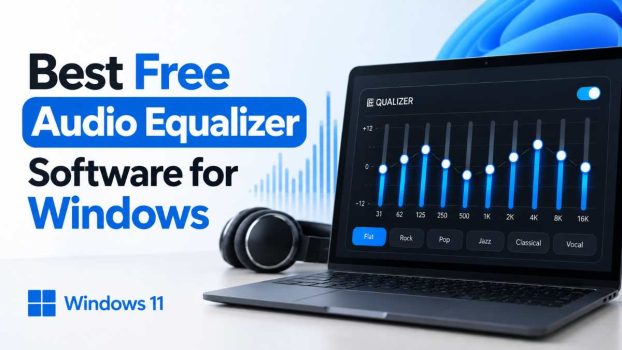
Windows 11 and Windows 10 don’t ship with a real system-wide graphic equalizer. What you get instead — Bass Boost, Loudness Equalization, a handful of “Audio enhancements” toggles — depends entirely on your sound driver, and many PCs show none of these options at all. If your speakers sound thin, your headphones are too bright, or your movie dialogue keeps getting drowned out by explosions, the fix is a dedicated equalizer app.
The good news: some of the most capable EQ tools available for any platform happen to be free and open-source. Below is a practical rundown of the best free options for Windows 11 and Windows 10 in 2026, what each one is actually good for, and where to download them.
Quick picks before you dive in
- Want the most powerful, no-cost option and don’t mind a slightly technical setup? Equalizer APO + Peace GUI.
- Want something you can install and be using in two minutes? FxSound.
- Need separate EQ profiles for game audio, chat, and music? SteelSeries GG Sonar.
- Doing podcasting, streaming, or need to route audio between apps? Voicemeeter.
- Just want your music player’s built-in EQ? VLC or foobar2000.
Now let’s go through them in detail.
1. Equalizer APO — the most powerful free option
Equalizer APO is widely regarded as the most powerful free audio equalizer available for Windows, operating directly within the Windows audio processing pipeline rather than bolting on a separate audio engine. Because it hooks into Windows’ own audio infrastructure as an Audio Processing Object, it applies to every app, every output device, and every audio format on your system — not just one media player.
What it’s good for: Serious tuning. It supports both graphic and parametric EQ, arbitrary numbers of bands, and can load headphone/speaker correction profiles from community databases like AutoEQ. It integrates directly with the Windows audio pipeline and doesn’t rely on driver hacks or per-app injection methods that can break after updates, and in real-world testing it stays reliable across sleep cycles, device reconnects, and Windows feature updates.
The catch: Equalizer APO’s own configuration interface is a plain text config file — functional, but not friendly. Almost everyone pairs it with a graphical front-end (see Peace below).
Download: Official project page on SourceForge — search “Equalizer APO SourceForge” or go directly to sourceforge.net/projects/equalizerapo/. It supports Windows 7 through Windows 11, 32-bit and 64-bit.
Setup tip: During installation, you’ll be asked which playback/recording devices to attach the APO filter to — pick your default output device. A reboot is required after install and after most driver-level changes.
2. Peace GUI — the equalizer APO must-have companion
Peace Equalizer is a graphical interface for Equalizer APO, not a separate replacement audio engine. On its own, Equalizer APO has no visual sliders — Peace is what turns it into an actual usable equalizer with draggable bands, a real-time graph, presets, and effects like crossfeed, delay, and balance correction.
What it’s good for: Making Equalizer APO approachable. Peace offers both a simplified and an advanced view, so users can grow into the software at their own pace. It also ships with a library of headphone-correction presets sourced from independent measurement databases, which is genuinely useful if you own popular headphones and want a scientifically tuned starting point rather than guessing.
The catch: Peace requires Equalizer APO to already be installed — it’s not a standalone download. One long-running annoyance noted by users is that changing presets can cause the window to close and reopen, and per-device profile management (e.g., separate curves for speakers vs. a mic) isn’t as clean as some rivals.
Download: Search “Peace equalizer APO GUI” — it’s most commonly distributed via SourceForge and hydrogenaud.io community links. Install Equalizer APO first, then install Peace on top of it.
3. FxSound — the easiest free standalone equalizer
If Equalizer APO + Peace sounds like more setup than you want, FxSound is the answer. FxSound is the easiest free standalone choice, presenting presets, bass boost, clarity, surround simulation, and a 9-band equalizer in a simple interface.
Formerly a paid product (DFX Audio Enhancer), FxSound has become open-source, offering free software that enhances sound quality, increases volume, and amplifies bass, with an equalizer, various effects, and presets for a personalized audio experience. The new version includes updated presets, a revamped parametric equalizer, and convenient keyboard shortcuts. Unlike its old trial-based model, the current FxSound is free to keep using indefinitely, not a time-limited demo.
What it’s good for: People who want better sound now, without learning parametric EQ theory. It runs system-wide, auto-detects most audio sources, and its presets (Music, Movies, Gaming, Voice) are genuinely well-tuned out of the box. It applies sound adjustments to the whole operating system, including audio from games or your favorite music player, and its default General profile boosts clarity, bass, and dynamism for a fuller sound, while nine separate frequency bands remain available for manual tweaking.
The catch: Less granular control than Equalizer APO — nine bands vs. potentially dozens, and no support for importing external correction curves.
Download: Official site — fxsound.com/download. Builds are available for both Intel/AMD (x86/x64) and Windows on ARM64.
4. SteelSeries GG Sonar — best for gamers
SteelSeries GG Sonar is a gaming-focused audio suite with equalizers and virtual devices for game, chat, media, auxiliary, and microphone channels, and it’s especially useful if you want different EQ settings for gameplay versus voice chat. SteelSeries describes Sonar EQ as a software-based parametric equalizer built for PC gaming, distinct from Engine EQ, which is a headset-configuration feature — Sonar EQ is the broader software-based feature that isn’t limited to SteelSeries hardware.
What it’s good for: Anyone who wants to boost footstep audio in competitive shooters without also blasting out music or Discord chat at the same volume — because Sonar splits your audio into separate virtual channels you can EQ independently. It can separate audio sources that Windows normally groups together, which is genuinely overkill if all you want is a simple music equalizer, but valuable for gamers who need per-channel control.
The catch: It’s a heavier install (part of the full SteelSeries GG suite) and its layered virtual-device setup is more than most non-gamers need.
Download: Official SteelSeries site — search “SteelSeries GG” and select the Sonar module during setup. Free to use regardless of what headset or hardware you own.
5. Voicemeeter (Banana) — best for routing + EQ together
Voicemeeter isn’t marketed purely as an equalizer — it’s a virtual audio mixer — but it includes a genuinely capable EQ section and is a favorite among streamers, podcasters, and anyone who needs to route audio between multiple apps and devices.
Voicemeeter Banana is an advanced audio mixer application with virtual audio devices used to mix and manage audio sources from or to any audio devices or applications, covering three physical inputs/outputs and two virtual inputs/outputs. It’s endowed with new effects on all input strips, a high-end master parametric EQ on every bus, and a multi-format audio player/recorder. It offers a six-cell full parametric EQ on every bus, with the ability to apply independent equalization to each channel, useful for correcting mono-to-7.1 PA setups, and can even double as a stereo crossover for multi-way active speaker systems.
What it’s good for: Complex setups — mixing mic input with game/music audio for streaming, running separate EQ curves per output bus, or fixing multi-speaker configurations.
The catch: Steeper learning curve than any tool above. It’s a mixer first, equalizer second, and the interface can be intimidating if you just want simple bass/treble control.
Cost model: Voicemeeter Banana is distributed as donationware — you can install and use it fully for free, with donations optional based on your means.
Download: Official site — voicemeeter.com (select the “Banana” tab) or vb-audio.com.
6. Built-in equalizers in your media player
If you only care about music playback (not games, calls, or system-wide audio), you may not need a separate app at all.
- foobar2000 includes a built-in graphic equalizer component. The Equalizer DSP is an 18-band graphic equalizer based on the SuperEQ library, and it can be added as a standard component during setup — no separate download needed beyond the player itself.
- VLC Media Player has a 10-band graphic equalizer built into its Effects menu (Tools > Effects and Filters > Audio Effects > Equalizer), with genre-based presets included.
What it’s good for: People who do all their listening inside one app and don’t need the EQ to apply to Spotify, YouTube, or games.
The catch: Only affects audio played through that specific application — nothing system-wide.
Comparison at a glance
| Tool | Best for | Bands | System-wide? | Setup difficulty |
|---|---|---|---|---|
| Equalizer APO + Peace | Audiophiles, precise tuning | Unlimited (parametric) | Yes | Moderate |
| FxSound | Fast, simple improvement | 9-band | Yes | Easy |
| SteelSeries GG Sonar | Gamers needing per-channel EQ | Parametric, per-channel | Yes (via virtual devices) | Moderate |
| Voicemeeter Banana | Streamers, complex routing | 6-cell parametric per bus | Yes | Advanced |
| foobar2000 / VLC | Music-only listening | 10–18 band graphic | No (app-only) | Easy |
How to choose
Think about where you actually need the sound improved:
- Everything on your PC (games, browser, calls, music) needs better bass/clarity, and you want minimal fuss: start with FxSound. You can always add Equalizer APO later if you outgrow it.
- You own specific headphones and want a scientifically accurate correction curve: go straight to Equalizer APO + Peace, and look up your headphone model in a database like AutoEq to import a ready-made profile.
- You’re gaming competitively and want louder footsteps without blowing out your Discord chat volume: SteelSeries GG Sonar’s per-channel EQ is purpose-built for this.
- You stream, podcast, or need to mix multiple audio sources into one output (or split one input across several destinations): Voicemeeter Banana is the right tool, even though it takes longer to learn.
- You only listen to music inside one player: skip standalone software entirely and use the EQ already built into VLC or foobar2000.
Setup and safety notes
A few practical things worth knowing before you install anything:
- One system-wide EQ at a time. Windows audio enhancements, headset companion apps, spatial audio, virtual surround, loudness tools, and third-party EQ software can all try to process the same signal at once — stacking too many of them is the most common cause of distorted or hollow-sounding audio. If sound starts distorting after installing an equalizer, turn off Windows’ own “Audio enhancements” for that device in Sound Settings, and disable any headset manufacturer’s software EQ so they’re not fighting each other.
- Graphic vs. parametric EQ. A graphic equalizer gives you fixed frequency sliders (60 Hz, 1 kHz, 16 kHz, etc.) and is easier to use, while a parametric equalizer lets you choose the exact frequency, gain, and filter width for more precise but more technical control. If you’re new to equalization, start with a graphic EQ or presets before building custom parametric filters.
- System-wide doesn’t always mean total coverage. Software equalizers can still miss applications and audio drivers that bypass the normal Windows audio-effects path — exclusive-mode WASAPI audio in some music players and pro-audio interfaces, for instance, may not pick up system-level EQ processing.
- Download only from official sources. Especially for Equalizer APO and Peace, stick to the official SourceForge/project pages rather than third-party “download” aggregator sites, some of which bundle unwanted extra software with the installer.
Bottom line
For most Windows 11/10 users in 2026, the honest recommendation is: try FxSound first — it’s genuinely free (no more trial restrictions), installs in minutes, and noticeably improves most speakers and headphones with zero technical knowledge required. If you find yourself wanting finer control, more bands, or headphone-specific correction curves, graduate to Equalizer APO with the Peace interface — it costs nothing and remains the most capable free equalizer on the platform. Gamers and streamers have their own specialized best fits in SteelSeries GG Sonar and Voicemeeter Banana, respectively, both free to use in full.
Whichever you pick, give yourself ten minutes with a few presets before building your own curve — most of these tools already include well-tuned starting points that get you 90% of the way to better sound with a single click.
Frequently asked questions
Does Windows 11 have a built-in equalizer? Not a universal one. Windows 11 does not include a true multi-band graphic equalizer. What you see under Sound Settings > Device Properties > Additional device properties (or the classic Enhancements tab) depends entirely on your audio driver — some PCs show Bass Boost and Loudness Equalization, others show nothing at all. For consistent, reliable EQ control across every device and app, a dedicated third-party tool is the only real option.
Will an equalizer app slow down my PC or add noticeable audio lag? Modern EQ tools like Equalizer APO, FxSound, and Voicemeeter process audio in real time with minimal CPU overhead on any PC built in the last decade. Latency is typically a few milliseconds — imperceptible for music or movies. If you’re doing latency-sensitive work like live audio monitoring or musical performance, test your specific setup, but for everyday listening and gaming it’s a non-issue.
Is it safe to run more than one equalizer at the same time? Technically yes, but it’s not recommended. Running Equalizer APO alongside FxSound, or leaving Windows’ own audio enhancements switched on at the same time as a third-party EQ, tends to cause distortion, clipping, or a hollow, over-processed sound because each tool is boosting the same frequencies independently. Pick one primary equalizer, turn off Windows’ built-in enhancements for that device, and disable any equalizer built into headset or speaker manufacturer software.
Which free equalizer gives the most precise control? Equalizer APO, especially when paired with the Peace interface. It supports parametric EQ with as many bands and filter types as you want, plus the ability to import measurement-based correction curves for specific headphone or speaker models. Nothing else on this list offers that level of granularity for free.
Can I use an equalizer with Spotify, YouTube, or Netflix? Yes — that’s the main advantage of system-wide tools like Equalizer APO, FxSound, Voicemeeter, and SteelSeries GG Sonar. Because they process audio at the Windows system level rather than inside a single application, they affect sound from browsers, streaming apps, and games alike. Player-specific equalizers (foobar2000, VLC) only affect audio played through that particular program.
Do any of these work with Bluetooth headphones? Generally yes, since they process audio before it reaches the output device, regardless of whether that device is wired or Bluetooth. That said, some Bluetooth codecs and driver combinations can occasionally interfere with system-level audio processing objects like Equalizer APO — if you notice no effect, check that the EQ is applied to the correct playback device in its settings, since Windows can silently switch your default output device when a Bluetooth device connects or disconnects.
What’s the safest way to download these tools? Always download directly from each project’s official site or its official page on a recognized host — SourceForge for Equalizer APO and Peace, fxsound.com for FxSound, voicemeeter.com/vb-audio.com for Voicemeeter, and steelseries.com for GG Sonar. Avoid generic “download portal” sites that repackage installers, since these sometimes bundle adware or outdated, unpatched versions alongside the real software.